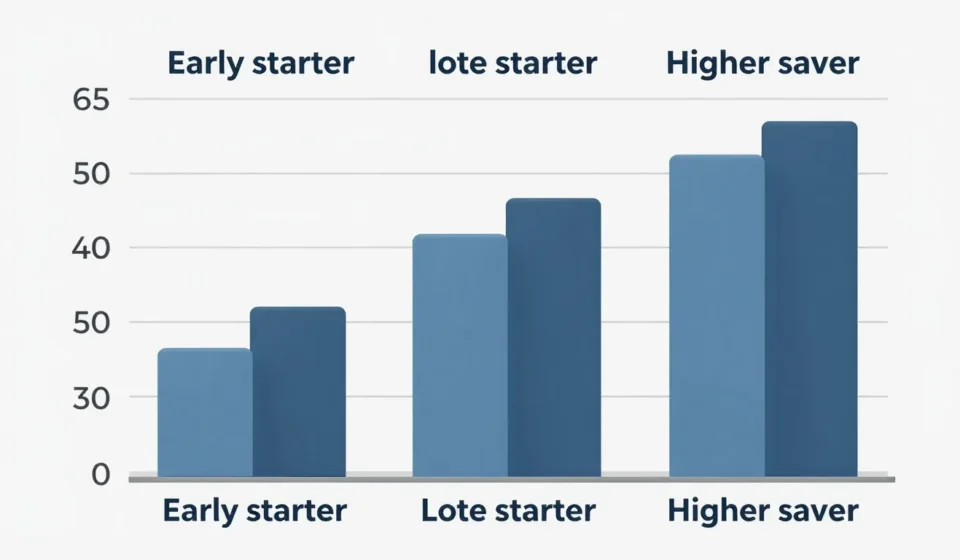
See Compound Interest in Action: Real Numbers for Different Savings Rates and Timelines

Compound Interest Growth: Why It’s Called the 8th Wonder
Albert Einstein reportedly called compound interest the 8th wonder of the world, and for good reason: the power of compound interest growth can transform modest savings into substantial wealth over time. Those who understand it earn it; those who don’t pay it.
The principle is simple: you earn interest on your principal and on the interest you previously earned. Over long periods, this creates exponential growth.
In this article, we'll look at real numbers across three different savings scenarios. You'll see exactly how much time and rate matter when building your nest egg.
The examples use no hypothetical magic — just the math that has worked for generations of patient investors.
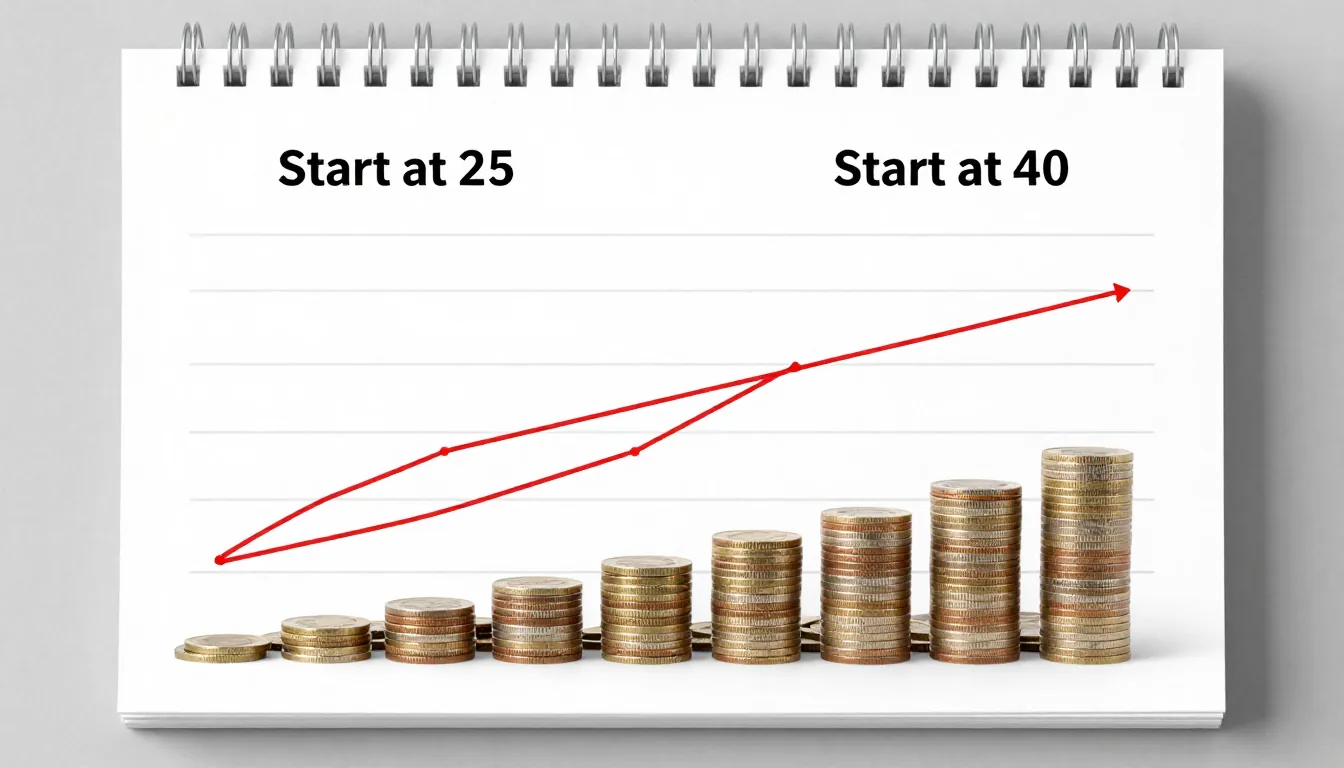
Three Scenarios, One Compounding Reality
Scenario A: The Early Starter
Meet Sarah, who starts saving $200 per month at age 25. She earns an average annual return of 7% (a realistic long-term stock market return).
She continues until age 65 — 40 years of consistent saving.
Total contributions: $200 × 12 × 40 = $96,000. But thanks to compounding, her final balance is much higher.
Using the future value of an annuity formula: FV = P × [((1 + r)^n – 1) / r], where P = $200, r = 0.07/12 ≈ 0.005833, n = 40×12 = 480.
Computation: FV ≈ 200 × [((1.005833)^480 – 1) / 0.005833] ≈ 200 × (31.409 – 1) / 0.005833 ≈ 200 × 5211 ≈ $1,042,200. So Sarah ends up with over $1 million — a classic example of compound interest growth in action.
Scenario B: The Late Starter
Now consider John, who starts at age 40 with the same $200 per month and same 7% return. He saves for only 25 years until age 65.
Total contributions: $200 × 12 × 25 = $60,000. At 7%: n = 25×12 = 300, r = 0.07/12.
FV ≈ 200 × [((1.005833)^300 – 1) / 0.005833] ≈ 200 × (5.714 – 1) / 0.005833 ≈ 200 × 808.6 ≈ $161,720. John ends up with about $162,000 — far less than Sarah, even though he contributed only $36,000 less in principal.
The difference is time.
Scenario C: The Higher Earner
Finally, consider Maria, who starts at age 25 like Sarah but saves $400 per month — double the amount. Same 7% return for 40 years.
Total contributions: $400 × 12 × 40 = $192,000. FV = $400 × 5211 ≈ $2,084,400.
Doubling the savings rate nearly doubles the final amount because the compounding factor is the same. But the starting age remains critical.
Real Numbers Comparison Table
Here’s a side-by-side look at the three scenarios at key milestones. This table vividly shows compound interest growth over time.
| Age | Sarah ($200/mo, start 25) | John ($200/mo, start 40) | Maria ($400/mo, start 25) |
|---|---|---|---|
| 30 | $14,500 | $0 | $29,000 |
| 40 | $68,200 | $4,100 | $136,400 |
| 50 | $200,000 | $49,000 | $400,000 |
| 60 | $522,000 | $157,000 | $1,044,000 |
| 65 | $1,042,000 | $162,000 | $2,084,000 |
John's balance barely grows after 60 because he has only 5 years left. Sarah's money has decades more time to compound.
This illustrates the enormous benefit of starting early — even small amounts become large over time.
How Different Rates Change the Outcome
What if the return is lower or higher? Let’s keep Sarah’s $200/month for 40 years but vary the annual return.
- 5% return: FV ≈ $305,000 (total contributions $96,000)
- 7% return: FV ≈ $1,042,000
- 10% return: FV ≈ $1,967,000
A 2% difference in annual return (from 5% to 7%) more than triples the final amount. That’s the leverage of rate on long-term compound interest growth.
To achieve higher returns, you typically need to invest in stocks rather than bonds or savings accounts, and you must accept more volatility. Notice how compound interest growth accelerates with higher rates.
Practical Takeaways for Your Savings Plan
Start Now, Even with Small Amounts
The best time to invest was 20 years ago. The second best time is today.
If you wait, the opportunity cost is enormous. For example, waiting just 5 years (starting at 30 instead of 25) with Sarah's numbers reduces the final amount by roughly $200,000.
The earlier you start, the more powerful compound interest growth becomes.
Increase Your Savings Rate Over Time
As your income grows, try to save a higher percentage. Maria doubled her savings and doubled her outcome.
Even increasing from $200 to $300 per month can add hundreds of thousands over 40 years. Doubling your savings rate directly boosts compound interest growth.
Use Tax-Advantaged Accounts
To maximize compound interest growth, use retirement accounts like 401(k)s and IRAs that allow your money to grow tax-deferred or tax-free. This avoids yearly taxes and keeps more money compounding.
For more Personal Finance strategies, check out our comprehensive guides. And for deeper dives, read how Investopedia explains compound interest or see SEC’s investor bulletin on compounding.