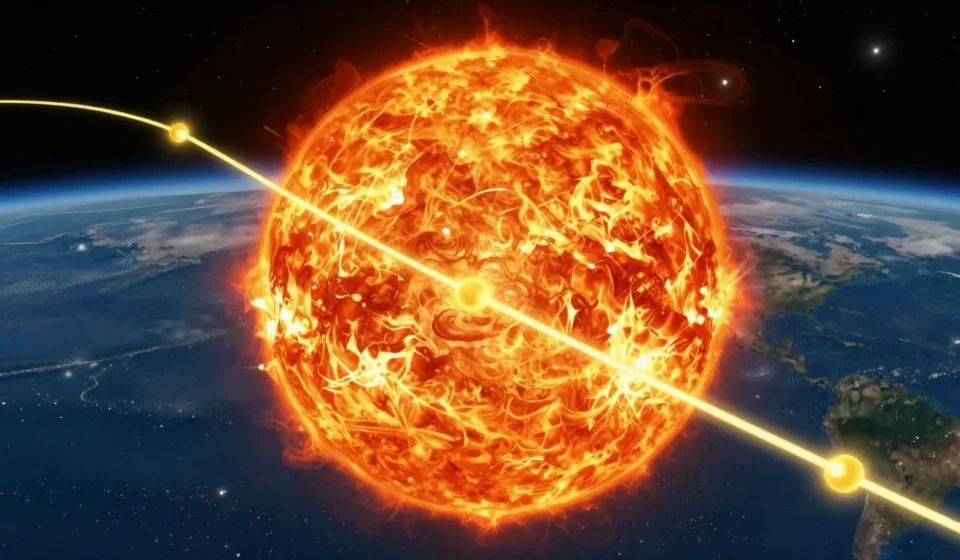
The Incredible 8-Minute Voyage: How a Photon Travels from the Sun to Your Eye

The Journey of a Photon from the Sun Begins in the Core
Deep in the Sun’s core, temperatures soar to 15 million degrees Celsius. Hydrogen atoms fuse into helium, releasing energy in the form of gamma rays. This is where the journey of a photon from the Sun begins, though it’s far from a straight shot.
These newborn photons are incredibly energetic but face a chaotic obstacle course. They immediately collide with surrounding particles, scattering in random directions.
This random walk means each photon takes an astonishing average of 100,000 years to finally escape the Sun.
The Long Labyrinth Through the Radiative Zone
After creation, photons enter the radiative zone, a dense layer of plasma that extends about 70% of the Sun’s radius. Here, they are absorbed and re-emitted countless times by atoms, losing energy with each interaction.
Imagine trying to run through a dense crowd blindfolded, bumping from person to person. That's exactly what a photon experiences for tens of thousands of years.
It slowly migrates outward, gradually transforming from a high-energy gamma ray into lower-energy X-ray and ultraviolet light.
Escaping the Convective Zone: The Final Stretch
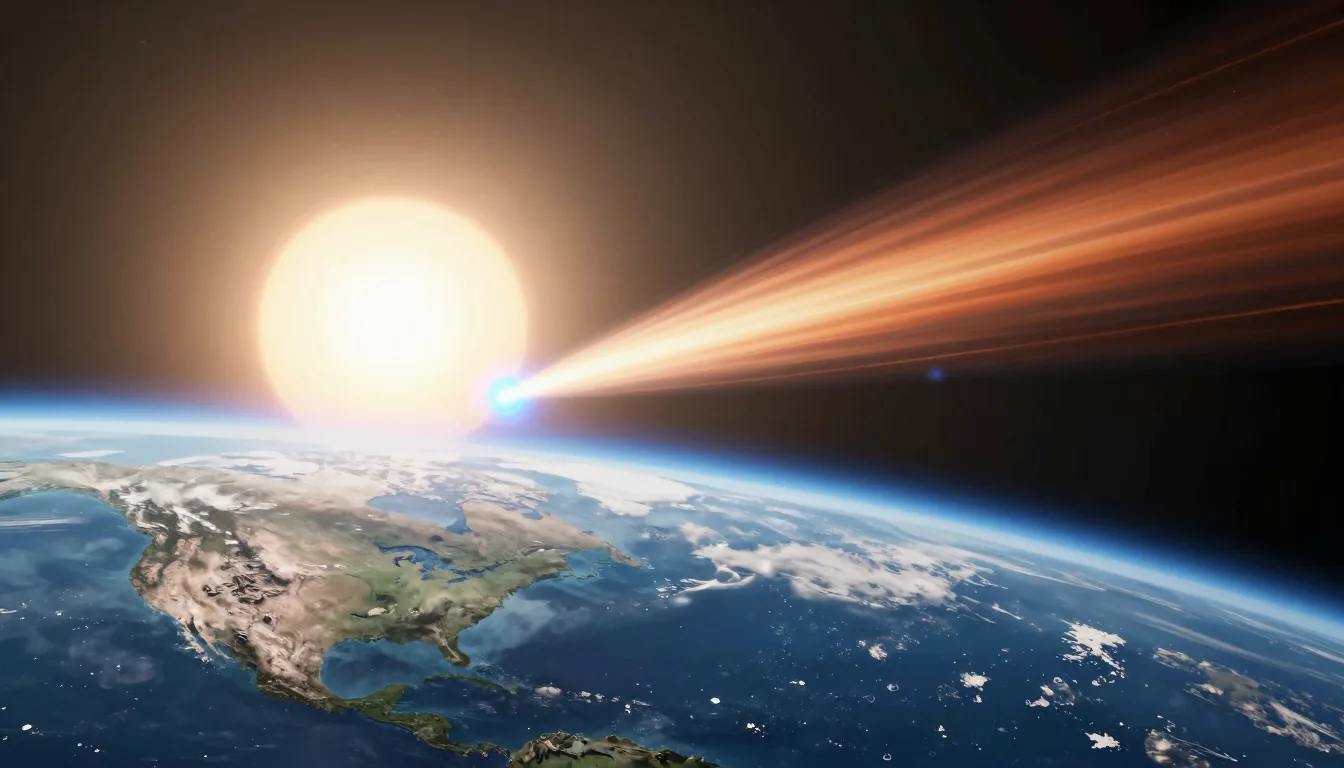
Near the Sun’s surface, the plasma becomes less dense and begins to churn like boiling water in the convective zone. Photons hitch rides on these rising bubbles, finally reaching the visible surface—the photosphere—after millennia of struggle.
Once free, the photon becomes sunlight, now in the visible spectrum. At this point, it has been transformed from dangerous gamma radiation to the gentle light that sustains life.
But its journey is far from over.
8 Minutes Through the Vacuum of Space
From the Sun's surface, the photon travels at the speed of light—299,792 kilometers per second. In the vacuum of space, there's nothing to slow it down.
This leg of the journey of a photon from the Sun is the fastest, covering 150 million kilometers in just 8 minutes and 20 seconds.
This interplanetary sprint is the easiest part of the journey. No collisions, no absorption, just a straight line through the cosmic void.
In those 8 minutes, the photon crosses the orbits of Mercury and Venus before finally reaching our planet.
Meeting Earth’s Atmosphere: A Gentle Filter
When the photon hits Earth's atmosphere, it encounters a mixture of gases. Some wavelengths scatter—that's why our sky is blue.
Others pass straight through, allowing us to see the Sun as a bright disk.
The atmosphere acts like a protective blanket, absorbing harmful ultraviolet rays while letting visible light reach the ground. Our photon, now visible light, navigates this molecular maze with ease.
From Your Eye to Your Brain: The Final Destination
The photon enters your eye through the cornea and pupil, then passes through the lens, which focuses it onto the retina. There, photoreceptor cells—rods and cones—capture it, converting light into electrical signals.
These signals travel along the optic nerve to your brain’s visual cortex, where they are interpreted as brightness, color, and shape. In that instant, you perceive the Sun’s light—a photon that began its journey over 100,000 years ago in the solar core.
To explore more fascinating cosmic journeys, check out our Popular Science & Space category. For deeper reading, visit NASA’s Sun page or learn about photon physics at Space.com.
Why This Epic Voyage Matters
The journey of a photon from the Sun is more than just a physics lesson—it’s a reminder of our connection to the universe. Every sunbeam carries ancient energy, transformed over eons before reaching us.
Understanding this process deepens our appreciation for sunlight and the delicate balance that makes life possible. Next time you feel the warmth on your face, remember the photon's epic adventure—a true cosmic miracle.
This knowledge turns a simple sunbeam into a story of cosmic proportions.