
What Exactly Are Gravitational Waves?
Gravitational waves are ripples in the fabric of spacetime, traveling at the speed of light. Predicted by Albert Einstein in 1916 as a consequence of his general theory of relativity, these waves are generated by the most violent events in the universe — merging black holes, exploding stars, or even the Big Bang itself.
Unlike water ripples, gravitational waves stretch and squeeze space itself as they pass. A passing wave would briefly make you taller and thinner, then shorter and wider, though by an almost imperceptible amount.
To detect them, scientists needed to measure distance changes smaller than a proton's width — an engineering miracle that took a century to accomplish.
How LIGO Catches an Invisible Signal
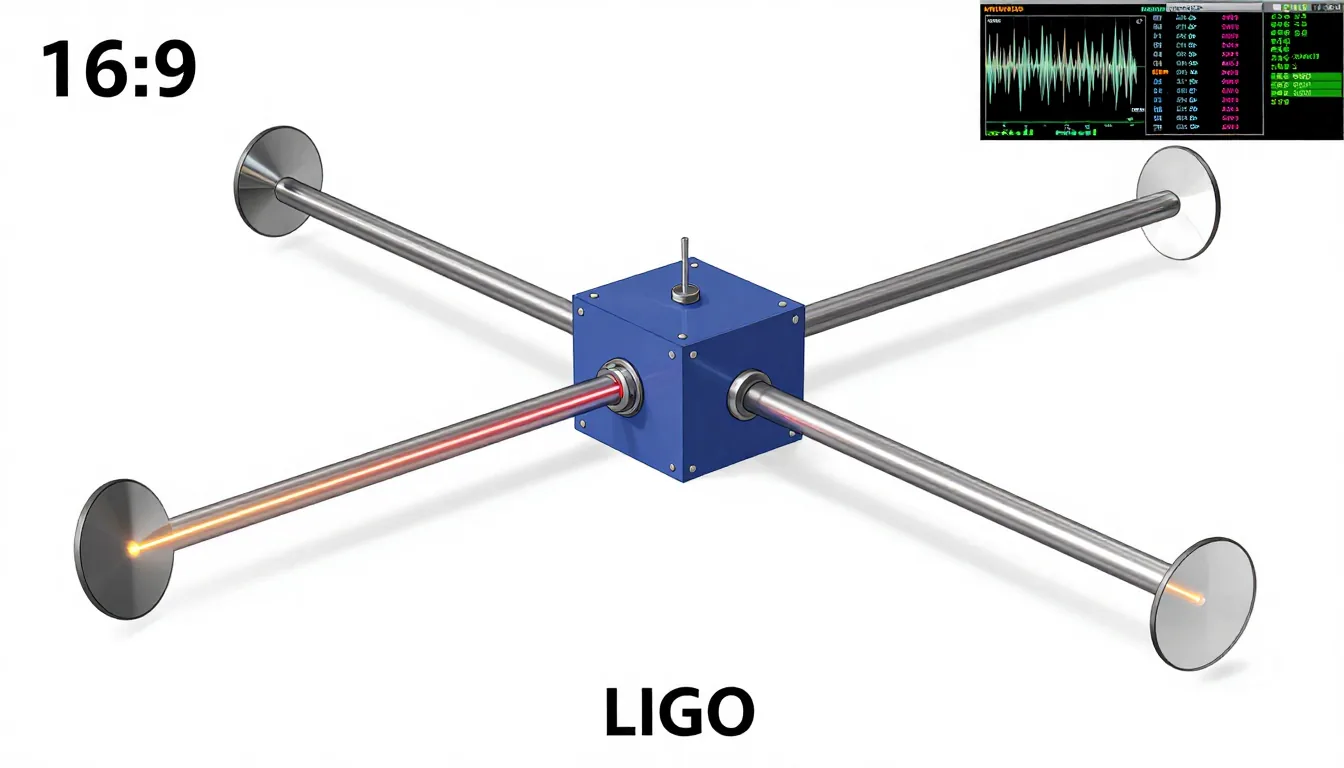
The Laser Interferometer Gravitational-Wave Observatory (LIGO) consists of two enormous L-shaped detectors, one in Louisiana and another in Washington state. Each arm is 4 kilometers long, housing a laser beam that travels down and back, bouncing off mirrors at the ends.
When a gravitational wave passes, it stretches one arm while compressing the other, causing the laser light to fall out of sync.
This interference pattern is detected by incredibly sensitive photodiodes. To isolate the signal from noise (like passing trucks or earthquakes), LIGO uses suspended mirrors with pendulums, and compares data from both sites.
A true gravitational wave will cause a near-identical pattern 10 milliseconds apart — the time it takes light to travel between the two detectors.
First Detection: The Sound of Two Black Holes Colliding
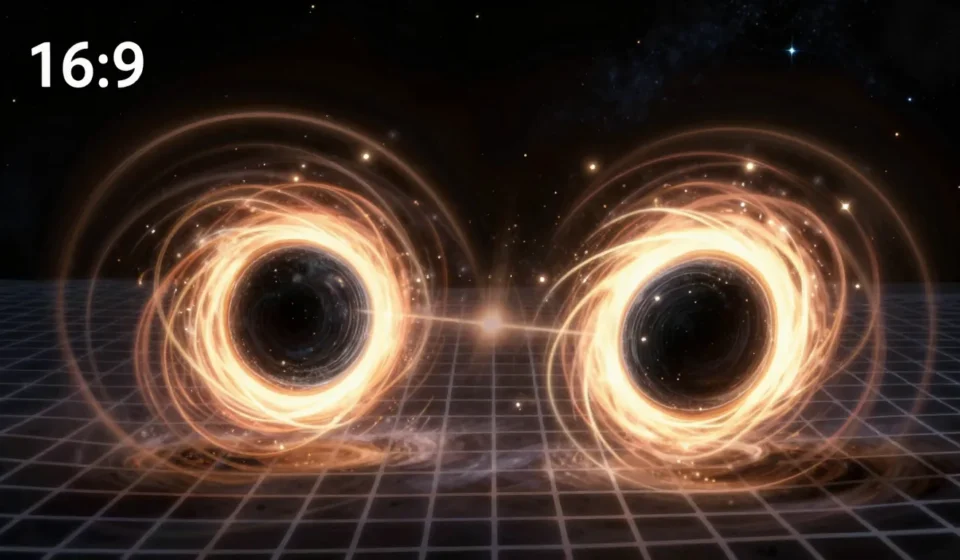
On September 14, 2015, a faint chirp reverberated through spacetime — the signal of two black holes, 1.3 billion light-years away, spiraling inward and merging. Each black hole was about 30 times the mass of our Sun, and they circled each other at half the speed of light before crashing together.
The energy released in that final fraction of a second was more than all the stars in the observable universe combined.
LIGO's data showed an ascending chirp as the black holes sped up, then a sudden cutoff as they merged. The waveform matched Einstein's equations perfectly.
This direct detection earned the 2017 Nobel Prize in Physics for Rainer Weiss, Barry Barish, and Kip Thorne, the architects of LIGO.
Why These Ripples Matter for Science
Gravitational waves open a completely new window on the cosmos. Unlike light, which can be blocked by dust and gas, gravitational waves pass through matter almost unaffected.
This means we can observe black hole mergers, neutron star collisions, and even the echoes of the Big Bang with unparalleled clarity.
These waves also enable tests of general relativity in extreme gravitational environments. By precisely matching observed waveforms to theoretical predictions, physicists can probe the limits of Einstein's theory.
Any deviation could signal the presence of new particles or modifications to gravity.
For instance, the 2017 detection of a neutron star merger (GW170817) provided a multi-messenger event seen in both gravitational waves and light, revealing where gold and platinum are forged in the universe. Since that historic detection, LIGO and its European counterpart Virgo have cataloged dozens of events.
These include binary black hole mergers of various masses and even a neutron star-black hole merger, confirming Einstein's theory to unprecedented precision.
Future space-based detectors like LISA will push the boundaries even further. By observing ripples from the dawn of the universe, we may glimpse the moments after the Big Bang itself.
Gravitational wave astronomy is still in its infancy, but it has already revolutionized our understanding of the cosmos. As detection sensitivity improves, we expect to observe gravitational waves from supernovae and spinning neutron stars, providing even richer cosmological insights.
To learn more about this exciting field, explore our Popular Science & Space section, or check out LIGO’s official site and Space.com’s coverage.