
Index Funds vs ETFs: Understanding the Passive Investing Landscape
When building a long-term portfolio, the debate between index funds vs ETFs often arises. Both offer low-cost, diversified exposure to market indices, but their structural differences matter for growth-oriented investors. Let’s break down the nuances to help you decide.
Cost Comparison: Expense Ratios and Trading Fees
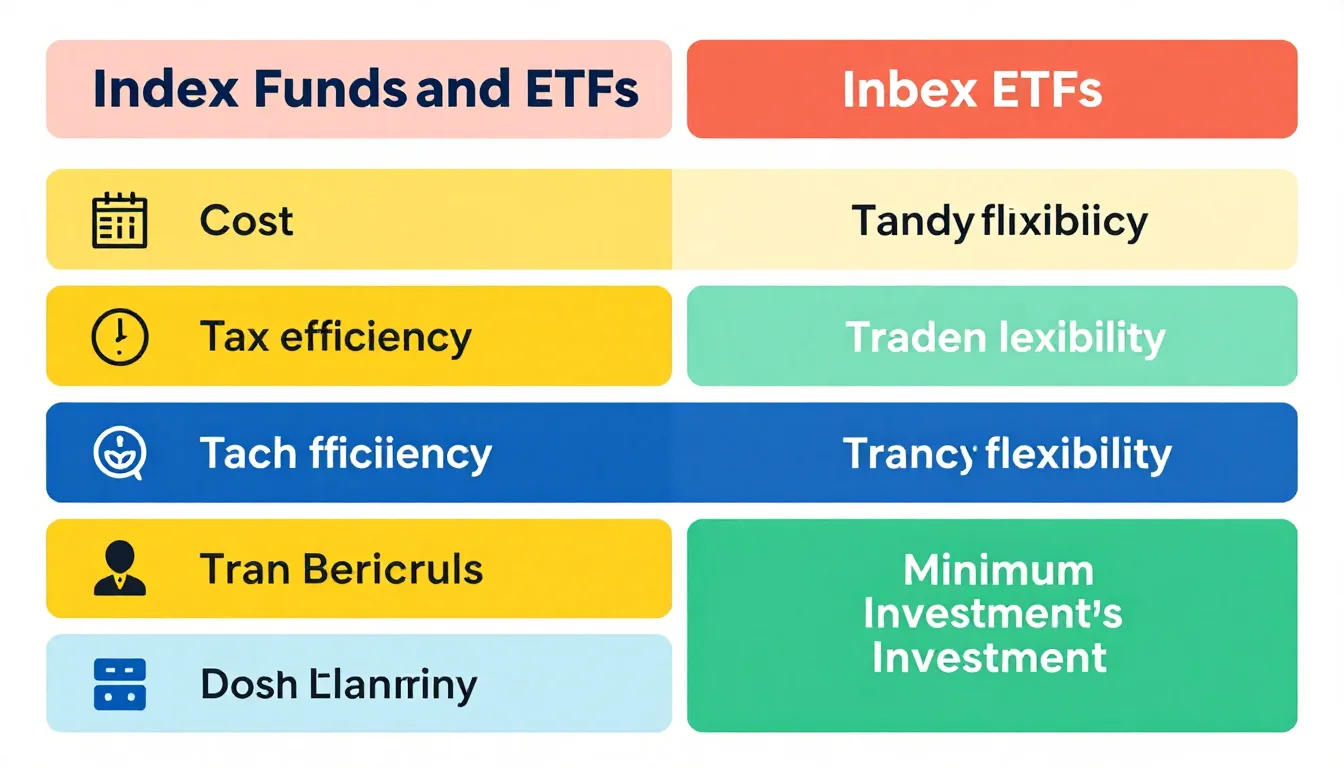
The decision between index funds vs ETFs often hinges on cost structure. Index funds typically have slightly higher expense ratios than ETFs due to fund management overhead.
However, many brokerages now offer commission-free ETF trades, narrowing the gap significantly. For long-term buy-and-hold strategies, the difference in annual fees is often minimal.
The Impact of Trading Costs
If you invest regularly with dollar-cost averaging, ETF trading costs can add up if you pay commissions. Index funds allow automatic investments without transaction fees, making them ideal for systematic contributions.
Over decades, these small savings compound significantly, boosting your net returns.
Tax Efficiency: A Key Factor for Growth
When evaluating index funds vs ETFs for tax efficiency, consider your account type. ETFs generally offer superior tax efficiency because of their unique creation/redemption mechanism.
This minimizes capital gains distributions, which is crucial in taxable accounts. Index funds, especially those from Vanguard, have patented structures that mimic ETF tax benefits, but not all providers do.
Tax-Loss Harvesting Opportunities
When considering index funds vs ETFs for taxable accounts, tax-loss harvesting becomes important. ETFs are more suitable due to their intraday trading and ability to swap similar ETFs. Index funds restrict trading to end-of-day NAV, making harvesting less flexible.
Trading Flexibility vs. Behavioral Discipline
The trading differences between index funds vs ETFs impact behavior. ETFs trade like stocks throughout the day, offering price transparency and limit orders.
This flexibility can be a double-edged sword: it tempts frequent trading, which undermines long-term returns. Index funds discourage market timing by only allowing end-of-day trades, enforcing discipline.
Automatic Investing and Reinvestment
The automation difference is a key factor in the index funds vs ETFs debate. Index funds excel at automatic investing and dividend reinvestment without fractional shares.
Many ETFs do not support fractional shares or auto-reinvest, though this is changing. For consistent growth through automation, index funds have an edge.
Minimum Investment and Accessibility
When comparing minimums, index funds vs ETFs differ significantly. Index funds often have higher minimum investments ($1,000–$3,000), while ETFs can be bought for the price of one share.
However, with fractional shares becoming common, ETFs are accessible to any budget. For small accounts, ETFs may be more practical initially.
Retirement Accounts: A Special Case
For retirement accounts, the index funds vs ETFs choice is simpler because tax advantages are already present. In tax-advantaged accounts like IRAs and 401(k)s, tax efficiency is irrelevant.
Index funds are often the default choice with no trading costs. ETFs may still be used for specific sector exposure, but the advantage narrows.
Performance and Tracking Error
Both index funds and ETFs aim to replicate index returns, but tracking error can vary. Investors should compare tracking error when choosing between them.
ETFs often have slightly lower tracking error due to more frequent rebalancing. However, for broad market indices, the difference is negligible over long periods.
Making the Choice for Your Portfolio
Ultimately, the best choice depends on your investment style. For disciplined, automated long-term growth in retirement accounts, Personal Finance experts often favor index funds.
For taxable accounts where tax-loss harvesting and flexibility matter, ETFs win. A blended approach also works well.
Whichever you pick, staying invested and keeping costs low is more important than the vehicle. Remember that both index funds vs ETFs are valid long-term options.
As Investopedia notes, both are excellent for passive investors. Remember to review your strategy periodically, as Morningstar research shows that the gap between them is narrowing.