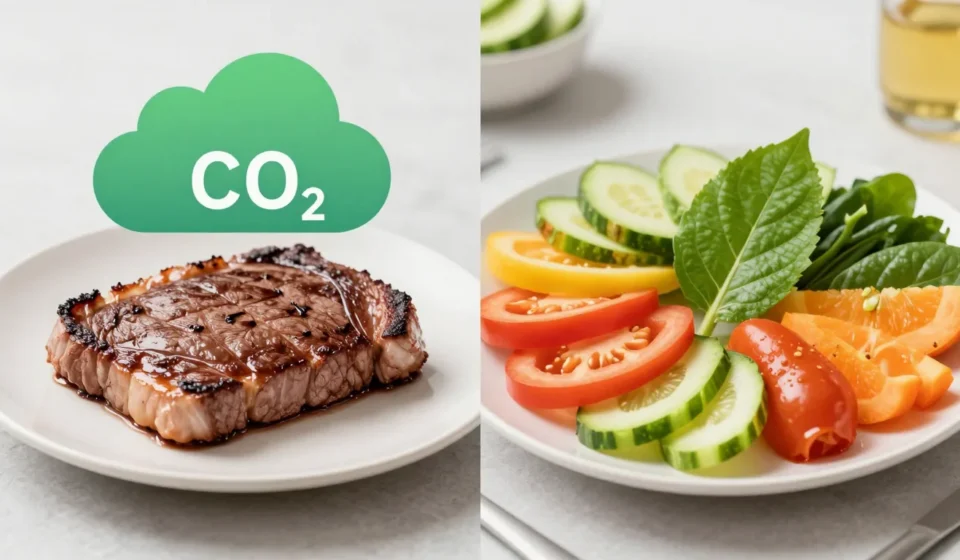

Plant-Based Carbon Footprint: The Real Impact of Food
When we talk about climate change, food systems often take a back seat to transportation or energy. Yet, agriculture accounts for roughly one-quarter of global greenhouse gas emissions. Shifting to a plant-based diet is one of the most powerful individual actions you can take to reduce your plant-based carbon footprint.
Studies show that meat and dairy production emit far more CO₂-equivalent per calorie than fruits, vegetables, legumes, and grains. For instance, beef produces about 60 kg of CO₂ per kg of meat, while lentils produce less than 1 kg.
Simply swapping beef for lentils once a week can save 1,080 kg of CO₂ annually—equivalent to driving 2,500 fewer miles.
Quantifying the Emissions of Common Foods
The science is clear: animal products have a disproportionately large environmental cost. According to data from Our World in Data, the highest-impact foods are lamb, beef, cheese, and pork.
On the other end, plant-based staples like tofu, nuts, and vegetables have a fraction of the impact.
- Beef (beef herd): 60 kg CO₂ per kg
- Cheese: 21 kg CO₂ per kg
- Pork: 7 kg CO₂ per kg
- Chicken: 6 kg CO₂ per kg
- Lentils: 0.9 kg CO₂ per kg
- Tofu: 2 kg CO₂ per kg
- Nuts: 0.3 kg CO₂ per kg
These figures come from a comprehensive meta-analysis by Our World in Data. Understanding these numbers helps you prioritize swaps for the greatest climate benefit. A lower plant-based carbon footprint is achievable with just a few changes.
Easy Dietary Swaps That Add Up
You don't need to go fully vegan overnight to make a difference. Even small changes, when adopted by many, can cut global emissions significantly.
Here are practical, low-effort exchanges:
- Swap beef for mushrooms in burgers and stews. A portobello mushroom burger has near-zero carbon footprint compared to beef.
- Replace cow’s milk with oat or almond milk. Oat milk produces about 80% less greenhouse gas than dairy.
- Choose legumes over poultry for protein. A lentil-based bolognese saves 90% emissions compared to chicken.
- Snack on dry-roasted chickpeas instead of cheese. Chickpeas emit 95% less CO₂ per calorie.
- Use avocado or hummus as spreads instead of butter or cream cheese. Both have a lower carbon footprint.
Research from the Proceedings of the National Academy of Sciences confirms that shifting to plant-rich diets could reduce food-related emissions by up to 70% by 2050. Each swap matters, and collectively they shrink your plant-based carbon footprint dramatically.
The Role of Food Waste in Your Carbon Footprint
Beyond choosing plant-based options, reducing food waste is crucial. Roughly one-third of all food produced is wasted, which also wastes the emissions from production.
By planning meals and using leftovers, you can further lower your overall carbon impact.
A study from the University of Michigan found that cutting food waste in half could reduce an average American’s dietary carbon footprint by about 12%. Combining waste reduction with a plant-based diet multiplies the benefits. Every effort to streamline your food choices supports a lower plant-based carbon footprint.
Beyond Carbon: Water and Land Savings
Reducing your plant-based carbon footprint also saves water and land. Producing one kg of beef requires about 15,000 liters of water, while one kg of vegetables needs 300 liters.
Similarly, animal grazing occupies 80% of agricultural land but provides only 18% of calories. By eating lower on the food chain, you free up resources for reforestation and biodiversity.
A 2021 study by Nature Food found that if everyone adopted a vegan diet, global agricultural land use could shrink by 75%, an area larger than the US, China, and the EU combined. That space could be rewilded, pulling CO₂ from the atmosphere naturally.
Common Myths About Plant-Based Diets
Some worry that plant-based diets are expensive or nutritionally inadequate. In reality, staples like beans, rice, and oats are among the cheapest foods, and protein needs are easily met with lentils, tofu, and quinoa.
Iron from plants is abundant when paired with vitamin C, such as spinach with lemon. Environmentally, even a diet with occasional meat can cut emissions by 40% compared to a high-meat diet. For more tips on sustainable eating, explore our Sustainability & Ecology archive.