
What Is Dark Energy? A Cosmic Puzzle That Rewrote Physics
Imagine tossing a ball upward only to have it accelerate—that’s the universe’s baffling behavior. The engine behind it is what is dark energy, a mysterious force pushing everything apart.
In the late 1990s, two teams studying distant supernovae expected the universe’s expansion to slow due to gravity. Instead, they found the expansion accelerating and coined the term dark energy.
Dark energy makes up about 68% of the universe’s total energy budget. We cannot see or detect it directly, yet its effects are undeniable, reshaping our understanding of reality.
The universe consists of roughly 5% normal matter, 27% dark matter, and 68% dark energy. This pie chart places dark energy as the dominant component, yet we know almost nothing about it.
The Accidental Discovery That Shocked Science
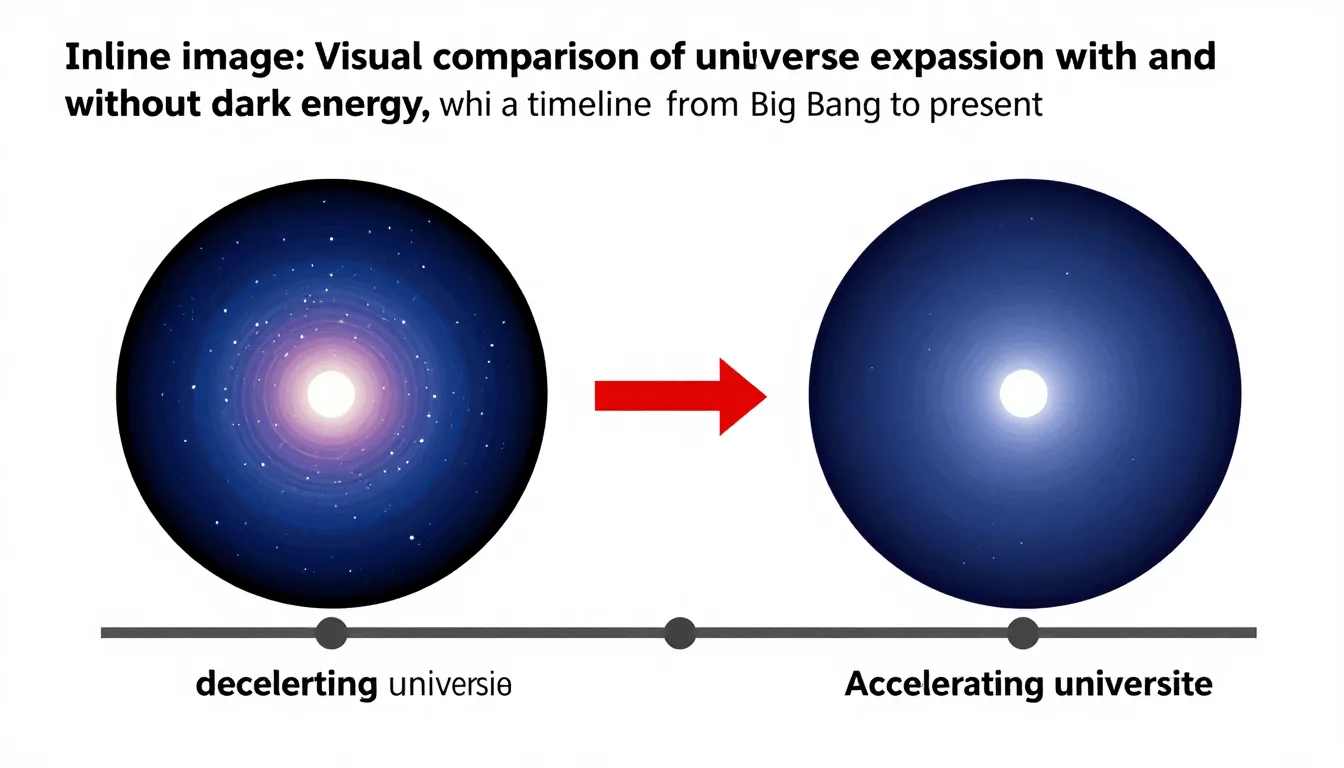
Dark energy’s story began with Type Ia supernovae used as cosmic yardsticks. Astronomers compared their brightness to distance to calculate the universe’s expansion rate at different epochs.
They were astonished: distant supernovae were dimmer than expected, implying the universe had expanded more slowly in the past. That means expansion is now accelerating—like a car speeding up as it runs out of gas.
In 2011, the leaders of both teams won the Nobel Prize for this paradigm-shifting discovery. The discovery earned Saul Perlmutter, Brian Schmidt, and Adam Riess the 2011 Nobel Prize in Physics, opening a new chapter in cosmology.
Leading Theories: Einstein’s Cosmological Constant
Albert Einstein anticipated something like dark energy with his cosmological constant. This term represents a constant energy density filling space uniformly, acting as repulsive gravity against the inward pull of matter.
The value needed to match observations is tiny but nonzero—about 10^-29 grams per cubic centimeter. Yet its cumulative effect over billions of light-years drives cosmic acceleration.
This concept aligns perfectly with observations of the cosmic microwave background and large-scale structure.
Alternative Ideas: Quintessence and Modified Gravity
Not everyone is sold on a constant. Some physicists propose quintessence—a dynamic field that changes over time, potentially causing acceleration to slow or even reverse in the future.
Others suggest modified gravity theories that tweak Einstein’s equations to explain acceleration without invoking dark energy. Quintessence models predict that dark energy may leave detectable imprints on the growth of cosmic structures.
For more context, explore our Popular Science & Space articles. External resources include NASA’s dark energy overview and Wikipedia’s detailed explanation.
What Does Dark Energy Mean for the Cosmos?
Dark energy dictates the universe’s ultimate fate. If it remains constant, expansion will accelerate forever, pulling galaxies so far apart that the night sky eventually goes black.
In a ‘Big Rip’ scenario, dark energy could become so strong that it tears galaxies, stars, and even atoms apart. Observations from the Planck satellite and the Dark Energy Survey probe dark energy’s behavior over time.
In a universe dominated by dark energy, gravitational structures like galaxy clusters will stop forming. Only bound groups like our Local Group will survive the accelerating expansion.
So far, it looks stubbornly constant, but mysteries remain. The cosmological constant is 10^120 times smaller than theoretical predictions—the worst prediction in the history of physics.
This ‘vacuum catastrophe’ hints that understanding what is dark energy might require a deeper theory of quantum gravity. Perhaps dark energy is a signpost to new physics beyond the Standard Model.
The Ongoing Hunt to Understand Dark Energy
Future missions like the Euclid spacecraft and NASA’s Roman Space Telescope will map billions of galaxies and cosmic ripples with unprecedented precision. Euclid, launched in 2023, aims to map the geometry of the dark universe with high precision.
Closer to home, the Dark Energy Spectroscopic Instrument (DESI) is creating the largest 3D map of the universe ever made. Early results suggest dark energy might be evolving over time, not constant as assumed.
If confirmed, this would revolutionize cosmology again. For now, this mysterious force remains the most profound question in modern science, challenging our notions of reality and pushing us to explore the unseen.