
Ever looked up at the night sky and wondered how old those twinkling stars really are? Astronomers have a clever way to figure out a star’s age using what’s called star age determination — a mix of stellar models and observations of luminosity, temperature, and rotation. It’s like reading the wrinkles on a cosmic face.
The Stellar Model: A Star’s Life Story on Paper
Astronomers build computer models that simulate a star's entire life, from birth to death. These models calculate how a star's internal pressure, temperature, and nuclear reactions change over millions or billions of years.
By inputting a star's mass and chemical composition, they can predict its brightness and surface temperature at different ages.
Think of it as a cosmic age calculator. The model tells you what a star should look like at 1 million years old versus 5 billion years old.
But models alone aren't enough — you need real observations to match them. This is the foundation of star age determination.
Luminosity and Temperature: The Hertzsprung-Russell Diagram
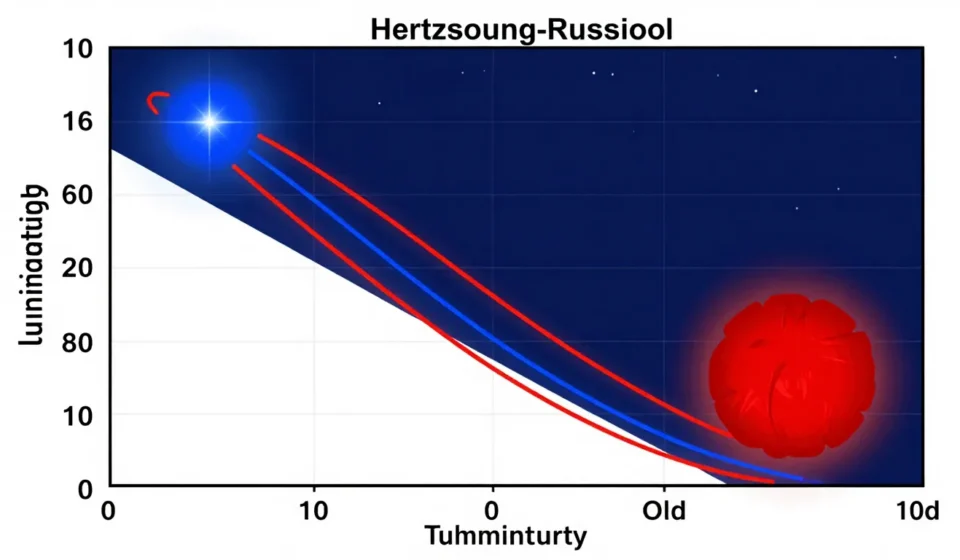
The most powerful tool is the Hertzsprung-Russell (H-R) diagram, which plots a star's luminosity against its surface temperature. Stars of different ages fall into distinct regions.
For example, young stars are often hotter and brighter, while older stars like our Sun sit on the main sequence.
By placing a star on this diagram and comparing it to model tracks, astronomers can estimate its age. This method is a core component of star age determination for many stars.
But there's a catch: the H-R diagram gives a range, not a precise number.
Rotation Rate: A Stellar Clock
Here's the surprising twist: a star's spin reveals its age. Young stars rotate fast, while older ones slow down due to magnetic braking — a stellar version of a spinning top losing energy.
Astronomers measure rotation periods using tiny brightness variations caused by starspots.
This technique, called gyrochronology, works like a clock. For Sun-like stars, the rotation-age relationship is well-calibrated.
It can pinpoint ages with accuracy of about 10–20%. For example, a star rotating once every 10 days is likely younger than our Sun, while one spinning every 30 days is older.
This rotational method is a key part of star age determination.
Asteroseismology and Lithium: More Cosmic Clocks
Asteroseismology — the study of starquakes — gives even more precision. Tiny oscillations in a star's brightness reveal its internal structure, much like earthquakes reveal Earth's interior.
These oscillations change with age, allowing astronomers to calculate the star's age to within a few percent. This provides another precise route to star age determination.
Another clue is lithium abundance. Stars burn lithium early in life, so a star with lots of lithium is likely young.
Conversely, old stars have depleted lithium. Combining these methods with the H-R diagram and rotation creates a robust age estimate.
Each method contributes to accurate star age determination.
Want to dive deeper? Popular Science & Space offers more cosmic insights. For the latest research, check out NASA’s official site or read about ESA’s Hipparcos mission that revolutionized stellar ages.
Why Star Age Determination Matters
Knowing a star's age helps us understand the history of our galaxy and the universe itself. The oldest stars, found in globular clusters, set a lower limit on the age of the cosmos.
Without these methods, we'd have no idea if a star is a newborn or a cosmic elder.
Next time you see a star, remember: its light carries secrets of its birth, its slow spin, and its long journey through time. Astronomers have cracked the code, and it's more surprising than you'd think.
Mastering star age determination unlocks the universe's timeline.