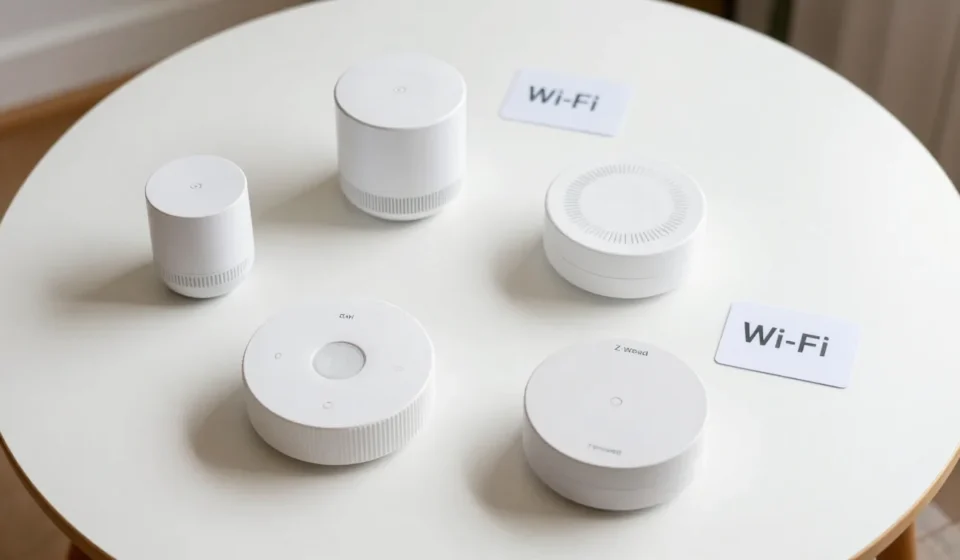
Which Smart Home Protocol Handles Interoperability Best? Testing Zigbee, Z-Wave, Thread, and Wi-Fi

Understanding the Protocol Landscape
Building a coherent smart home requires choosing a hub that bridges your devices. The four main protocols—Zigbee, Z-Wave, Thread, and Wi-Fi—each bring different trade-offs in interoperability, range, and setup complexity. Understanding these smart home protocols helps you avoid costly lock-in and frustration.
Zigbee vs Z-Wave: The Old Guard
Zigbee and Z-Wave are mesh-based protocols designed for low-power device communication. Zigbee operates on the 2.4 GHz band, while Z-Wave uses sub-GHz frequencies for better wall penetration.
Both require a hub but offer broad device compatibility.
Zigbee's open standard means more device variety, but interoperability can be spotty due to inconsistent certification. Z-Wave's stricter certification ensures smoother cross-brand operation, but its device ecosystem is smaller.
Range for both is roughly 30-50 meters per node, extended by mesh routing.
Setup ease: Z-Wave tends to pair more reliably out of the box, while Zigbee often needs a compatible hub like Amazon Echo Plus or SmartThings. Neither is truly plug-and-play for novices.

Thread: The New Contender
Thread is a newer mesh protocol backed by Google, Apple, and Samsung, designed specifically for IoT. It uses IPv6 for direct device-to-device communication, reducing hub dependency.
Thread devices can act as routers, and border routers connect Thread to Wi-Fi.
Interoperability is high thanks to the Matter standard, which ensures Thread devices work across ecosystems. Range is similar to Zigbee (30-50 meters per node), but setup is simpler—devices often pair via smartphone without a dedicated hub.
However, Thread device availability is still limited compared to older protocols.
For those starting fresh, Thread offers the best future-proofing. However, legacy device compatibility requires a bridge.
Wi-Fi: Ubiquitous but Flawed
Wi-Fi eliminates the need for a separate coordinator, but it consumes more power and can congest your home network. Wi-Fi devices rely on your router’s range, which is typically better (50-100 meters) but suffers from interference.
Interoperability is theoretically high because most devices speak standard HTTP/MQTT, but in practice, many require cloud subscriptions or proprietary apps. Setup is often as simple as scanning a QR code, but dependency on internet connectivity and higher latency are downsides.
Wi-Fi is best for high-bandwidth devices like cameras, but not ideal for battery-powered sensors. Consider using Wi-Fi only for devices that need constant streaming or high data rates.
Smart Home Protocols: Interoperability Comparison
When evaluating wireless standards for cross-brand compatibility, consider the following:
- Zigbee: Wide device choice, but inconsistent pairing. Best for lights and sensors.
- Z-Wave: Reliable pairing, smaller ecosystem. Strong for locks and security.
- Thread: Excellent future interoperability via Matter, limited current selection.
- Wi-Fi: Universal but power-hungry; prone to cloud dependency.
No single protocol dominates. A practical solution is a hub that supports multiple protocols, such as the Hubitat Elevation or Home Assistant with USB dongles. For example, the Zigbee Alliance maintains a certification database to verify device compatibility.
Ultimately, the best mix depends on your existing devices and future plans. Plan for growth by choosing a hub that supports firmware updates.
Range and Reliability
In real-world testing, Z-Wave's sub-GHz signals penetrate walls better than Zigbee's 2.4 GHz. A typical Z-Wave network can cover a 2,000 sq ft home with two intermediate nodes.
Zigbee suffers from Wi-Fi interference but benefits from higher data rates for OTA updates.
Thread's mesh is self-healing, but its range depends on the border router placement. Wi-Fi range is best in open spaces but drops with obstacles.
For whole-house coverage, a mix of Thread for critical sensors and Wi-Fi for high-bandwidth devices works well.
Reliability also depends on hub hardware. Dedicated hubs (e.g., Hubitat) outperform multipurpose hubs (e.g., Amazon Echo) in uptime and response speed.
Ease of Setup
Wi-Fi devices are generally easiest to set up via app, but integration with other platforms can require additional accounts. Zigbee and Z-Wave hubs often require manual pairing via a button press or a serial number.
Thread devices are almost as easy as Wi-Fi, with app-guided pairing.
For the least friction, choose a hub that supports Matter, which promises universal pairing across protocols. Currently, Apple HomePod and Google Nest Hub Max act as Thread border routers.
If you are comfortable with a little tinkering, platforms like Home Assistant give you the most control over all protocols, but the learning curve is steep. Consider starting with a user-friendly hub if you prefer simplicity.
Which Hub Should You Buy?
If you want one protocol to rule them all, Thread with Matter is the best long-term bet, but you will need to wait for device adoption. For an existing setup, a hybrid hub like SmartThings (v3) supports Zigbee, Z-Wave, Wi-Fi, and Thread via future firmware updates. Alternatively, Z-Wave Alliance certifies hubs that prioritize security.
In the end, the best hub is one that supports the devices you already own. Check compatibility lists before committing.
The ideal protocol that "plays nice" is the one your specific devices speak.
For more in-depth guides, visit our Tech & Gadgets category.