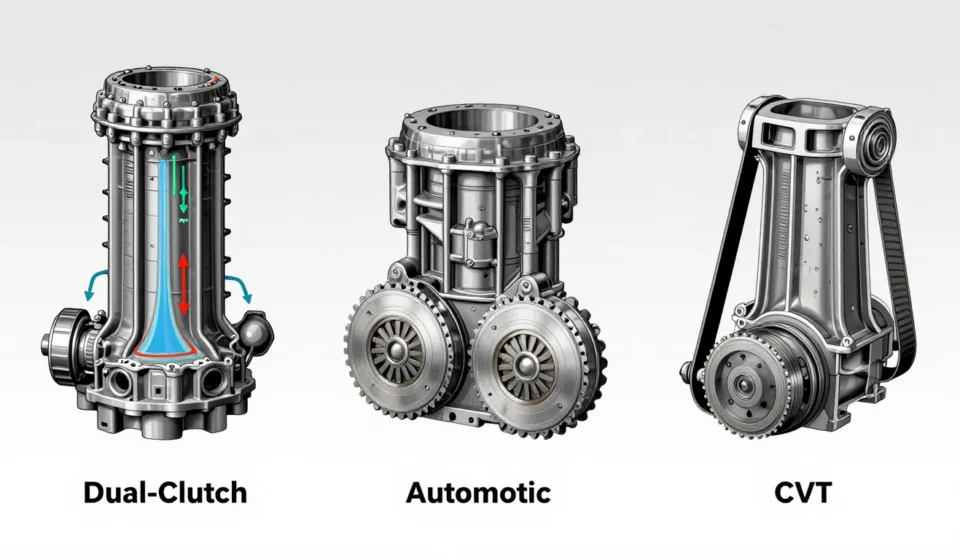

Understanding the differences between automatic transmission types is crucial before buying your next car. Three dominant designs—torque converter automatic, dual-clutch transmission (DCT), and continuously variable transmission (CVT)—offer radically different driving experiences. We’ll dissect their engineering, shift characteristics, and efficiency trade-offs so you can make an informed choice based on facts, not marketing hype.
The Mechanical Heart of Your Automatic
All automatic transmissions aim to decouple the engine from the wheels during stops and provide a range of gear ratios. How they achieve this drastically alters performance and fuel economy.
Torque converters use fluid coupling, DCTs use two independent clutches, and CVTs use a belt-and-pulley system. Each automatic transmission type has its own mechanical personality.
Torque Converter: Smooth but Slushy
The traditional torque converter automatic uses a hydraulic coupling filled with transmission fluid. The impeller (driven by the engine) spins the turbine (connected to the gearbox) through fluid movement.
This automatic transmission type provides smooth takeoffs and torque multiplication at low RPM, making it ideal for towing or stop-and-go traffic. Shift speeds are moderate—typically taking 200–400 milliseconds.
Efficiency suffers due to parasitic losses from fluid slip, leading to lower fuel economy compared to a manual or DCT. Blunt advice: if you prioritize comfort and durability over response, this is your choice.
But for performance driving, look elsewhere.
Dual-Clutch Transmission (DCT): Lightning Shifts
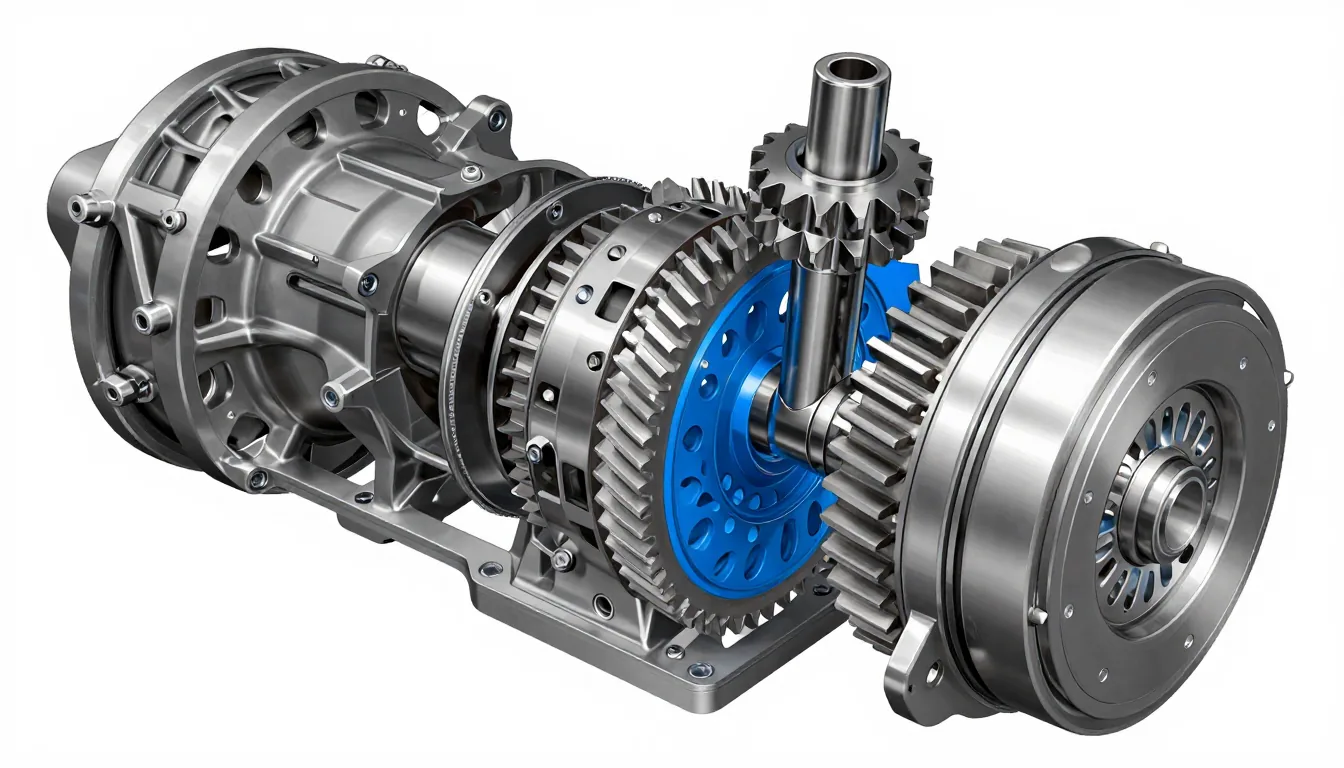
A DCT uses two concentric input shafts, each with its own clutch—one for odd gears (1,3,5) and one for even (2,4,6). This allows the next gear to be pre-selected while the current gear is still engaged.
This modern automatic transmission type results in shift times under 100 milliseconds, unmatched by any other automatic. The direct mechanical connection (via clutches) eliminates fluid losses, giving efficiency on par with manuals.
However, low-speed behavior can be jerky, especially in traffic. Best for sports cars and track use.
Trade-off: less smoothness in urban crawling.
Continuously Variable Transmission (CVT): Efficiency Champion
A CVT replaces fixed gears with a steel belt running between two variable-radius pulleys. By changing the pulley diameters, it offers an infinite number of ratios.
This automatic transmission type keeps the engine operating at its most efficient RPM for any given speed, conferring superb fuel economy—often 5–10% better than a torque converter automatic. Acceleration is seamless, but the monotone drone at high RPM can feel unpleasant to enthusiasts.
CVTs also struggle with high torque loads, making them rare in heavy-duty applications. Ideal for hybrids, econoboxes, and commuters.
Real-World Driving Impressions
You'll notice distinct differences in daily driving. A torque converter automatic feels smooth and relaxed, especially in traffic jams.
Dual-clutch transmissions deliver crisp, immediate shifts that enthusiasts love.
Each automatic transmission type offers distinct driving characteristics. CVTs, in contrast, can feel strained under hard acceleration as the engine holds high RPM.
Many modern CVTs include simulated shift points to mimic traditional automatics, improving the driving sensation.
If you frequently drive on highways, a CVT provides excellent fuel economy. For spirited back-road driving, a DCT is hard to beat.
The torque converter remains a solid all-rounder.
Maintenance and Longevity
Torque converter automatics are generally robust, with long service intervals for fluid and filter changes. DCTs require more frequent transmission fluid changes, often every 40,000 miles.
Understanding the maintenance needs of each automatic transmission type is crucial. CVTs have a reputation for being less durable, especially in high-mileage applications.
However, modern designs are improving, and many come with extended warranties. Always follow the manufacturer's service schedule.
Factor in potential repair costs when deciding among transmission types. A CVT replacement can be expensive, while DCT repairs often require specialized knowledge.
Which Automatic Transmission Types Win?
There is no universal winner. For raw acceleration and driver engagement, the DCT is unbeatable.
For maximum fuel efficiency and smoothness, a CVT (especially with hybrid assistance) takes the lead.
For towing, heavy loads, or a refined daily driver, the torque converter remains the benchmark. Consider your driving priorities: if you spend hours in traffic, a CVT or traditional automatic will serve you better; if you hit the track every weekend, a DCT is your only choice.
Remember, maintenance costs also differ: DCTs require precise fluid changes, while CVTs can be expensive to repair. Understanding these automatic transmission types empowers you to pick the right car.
Many modern vehicles now offer multiple automatic transmission types depending on trim level. For example, a compact hatchback might offer a CVT as standard, while the performance variant gets a DCT.
Similarly, luxury sedans often pair refined torque converters with eight or more gears. The choice ultimately hinges on how you drive and what you value most.
If you want to dive deeper into transmission engineering, browse our Automotive & Mobility category. External resources: How a Car Works – Transmission Section and Car and Driver DCT Explainers.