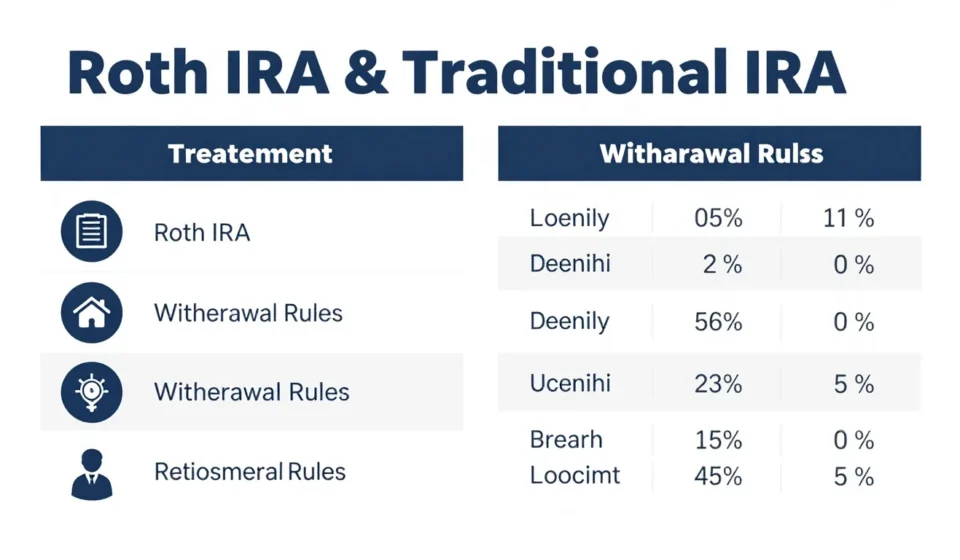

When planning for retirement, the choice between a Roth IRA vs Traditional IRA is one of the most debated decisions. Both offer tax advantages, but they work in opposite ways. Understanding the differences in tax treatment, withdrawal rules, and income limits is essential to pick the right account for your situation.
Roth IRA vs Traditional: Tax Timing Differences
The core difference is when you get the tax benefit. A Traditional IRA allows you to deduct contributions on your current tax return, reducing your taxable income now.
You pay taxes on withdrawals in retirement at your ordinary income rate.
A Roth IRA offers no upfront deduction. You contribute after-tax dollars.
The payoff comes later: qualified withdrawals in retirement are completely tax-free.
Which is better? It depends on your current tax bracket versus expected retirement bracket.
If you are in a higher bracket now and anticipate lower income later, Traditional is appealing. For early-career earners with a lower tax rate, Roth can lock in low taxes on future gains.
Withdrawal Rules: Flexibility and Penalties
Both accounts have penalties for early withdrawals before age 59½, but Roth offers more flexibility. With a Roth, you can withdraw your contributions at any time, tax-free and penalty-free.
This makes it a backup emergency fund, though not recommended.
Traditional IRAs penalize almost all early withdrawals with a 10% penalty plus income taxes. Exceptions exist for first-time home purchases ($10,000), education expenses, and medical emergencies.
After age 73, Required Minimum Distributions (RMDs) apply to Traditional IRAs, forcing you to withdraw a specific amount each year. Roth IRAs have no RMDs during the original owner’s lifetime, allowing your money to grow untouched.
Key Rule: The 5-Year Rule
Roth IRAs have a 5-year rule: you must wait five years after your first contribution to withdraw tax-free earnings. This is a critical nuance if you plan to use earnings before retirement.
Income Limits for Contributions and Deductions
Both accounts have income limits that affect eligibility. For Traditional IRAs, if neither you nor your spouse is covered by a workplace retirement plan, you can deduct contributions regardless of income.
However, if you are covered, the deduction phases out at certain modified AGI levels—for 2025, single filers lose the deduction between $77,000 and $87,000.
Roth IRA contributions also have phase-out ranges. In 2025, single filers can contribute fully if income is below $150,000, with a phase-out up to $160,000.
Married couples filing jointly have a phase-out range of $230,000 to $240,000. These figures adjust annually; always verify current limits on the IRS website.
The annual contribution limit for both accounts is $7,000 in 2025 ($8,000 if age 50+). You can contribute to both, but the total across all IRAs cannot exceed that limit.
Conversion Opportunities: Roth vs Traditional
You can convert a Traditional IRA to a Roth IRA, but you must pay income tax on the converted amount. This is known as a Roth conversion.
It can be beneficial if you expect higher taxes in retirement or want to avoid RMDs.
Conversions are especially useful in low-income years, such as between jobs or during retirement before Social Security begins. However, be aware of the pro-rata rule if you have both pre-tax and after-tax IRA balances.
Tax Diversification Strategy
Having both a Traditional and Roth IRA can create tax diversification in retirement. You can withdraw from your Traditional IRA in lower-income years and from your Roth in higher-income years to manage your tax bracket.
This flexibility is a powerful advantage of using both accounts strategically.
Choosing the Right Account for Your Situation
The Roth IRA vs Traditional decision ultimately hinges on your tax expectations. If you expect to be in a lower bracket in retirement, a Traditional IRA gives an immediate deduction now.
If you anticipate higher future income, a Roth IRA lets you pay taxes at today’s lower rates.
Consider your employer’s retirement plan. If you have a 401(k), you might still benefit from an IRA for additional savings.
Diversifying with both accounts can provide tax flexibility in retirement.
For more guidance on Personal Finance strategies, explore our library of resources. Review the latest contribution limits on the IRS website. Use a tax calculator from a trusted source like Fidelity to model your specific scenario.
In summary, the comparison between Traditional and Roth IRAs revolves around tax timing, withdrawal flexibility, and income limits. Both IRAs are powerful retirement tools.
Analyze your personal numbers before deciding. The key is to understand how each handles your unique tax situation and retirement timeline.