
The Cosmic Telephone Line
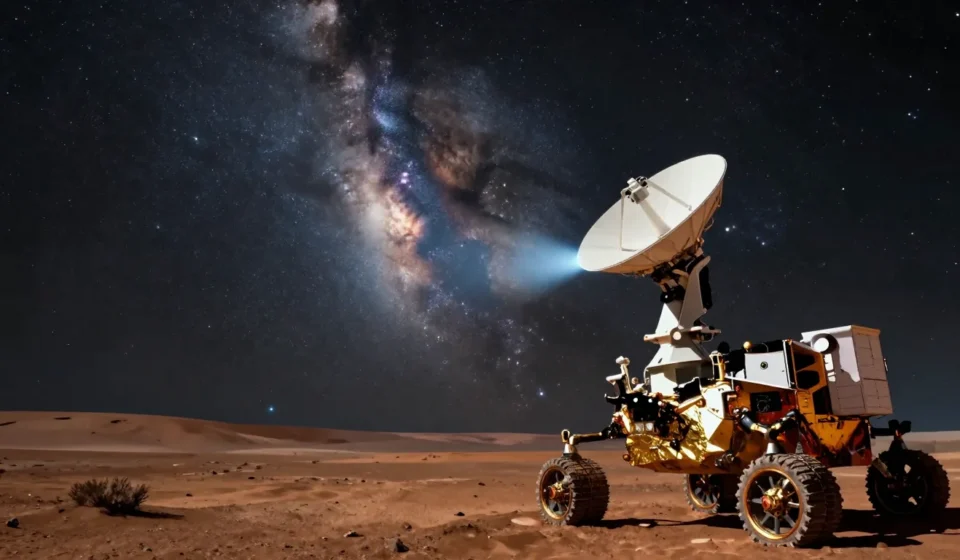
Imagine trying to call a friend on the other side of the planet—but your voice takes 20 minutes to arrive, and that’s the reality for NASA’s Mars rovers. So how do rovers communicate with Earth across millions of miles? It’s not magic, but a network of giant radio dishes called the Deep Space Network (DSN).
Think of the DSN as a cosmic telephone exchange, with antennas strategically placed around the globe to stay in constant touch with our robotic explorers. The DSN has three facilities—in California, Spain, and Australia—so that as Earth rotates, at least one can always “see” Mars.
These dishes, some as wide as 70 meters, listen for the faint whispers from rovers like Perseverance and Curiosity. The signals travel at the speed of light, but even that swiftness takes 4 to 24 minutes for a one-way trip, depending on the planets’ orbital positions.
That delay is the single biggest challenge in Martian communication.
How Do Rovers Communicate with Earth: The Deep Space Network
The DSN isn’t just a bunch of dishes; it’s a sophisticated system of phased arrays, cryogenically cooled receivers, and error-correction codes. Each dish can transmit high-power radio waves to a rover’s small antenna (usually a dish less than a meter wide).
The rover’s own transmitter is puny—just tens of watts, like a dim lightbulb.
To pick up that weak signal, Earth’s receivers must be incredibly sensitive, cooled to near absolute zero to reduce noise. Data is sent using deep-space protocols like the Consultative Committee for Space Data Systems (CCSDS) standards.
These include powerful error-correction codes that allow the signal to be reconstructed even if bits are lost.
Think of it like writing a letter with redundancy: “I love you” becomes “I l-love you-ou” so that even if some words are smudged, the meaning survives. This is critical because cosmic noise and solar interference can scramble the message.
But the DSN doesn’t just listen; it also talks.
To command a rover, a massive dish beams a frequency around 8 GHz (X-band) or 32 GHz (Ka-band) toward Mars. The signal spreads out like a cone, so by the time it reaches the rover, only a tiny fraction of the original power remains.
Yet the rover’s sensitive receiver can decode it, thanks to advanced error correction and a high-gain antenna that points precisely at Earth.
For more details, visit NASA’s Deep Space Network page. This network is essential for understanding how do rovers communicate with Earth.
Signal Delays: Playing the Waiting Game
When a rover takes a photo, it can’t just send it instantly. The time lag means mission controllers must plan commands days in advance.
For example, if a rover spots an interesting rock, it might take a picture, but by the time the image reaches Earth, the rover has already moved on.
Engineers call this “time-delayed robotics,” and it forces a unique approach: give the rover autonomy to act on its own while waiting for instructions. The delay isn’t constant.
This variability is another challenge for how do rovers communicate with Earth.
When Mars is closest (about 55 million kilometers), signals take around 3 minutes one-way. At opposition, when Mars is behind the Sun from our perspective, communication can black out for weeks.
That’s why missions are designed with “safe modes” and pre-programmed tasks to keep rovers busy during quiet periods, like sending a child to summer camp with a schedule—they can handle daily routines, but big decisions need a parent’s call. Learn more about signal delays from NASA’s Mars Communications page.
Data Rates: From Kilobits to Megabits
You might wonder: how fast can a rover send data? It’s painfully slow by earthly standards.
The Spirit and Opportunity rovers achieved only about 3.5 to 12 kilobits per second—slower than a dial-up modem.
Curiosity improved to roughly 256 kbps, and Perseverance can hit up to 2 megabits per second with its more powerful X-band radio and larger antenna. This is a key part of how do rovers communicate with Earth efficiently.
But those rates are only possible when Mars is relatively close and the orbiter acts as a relay. This relay configuration is a cornerstone of how do rovers communicate with Earth effectively.
Rovers often bounce signals off orbiting spacecraft like the Mars Reconnaissance Orbiter (MRO) or the European Trace Gas Orbiter (TGO). These orbiters have much larger antennas and better line-of-sight to Earth, so they can receive data from the rover at high rates (up to 2 Mbps) and then beam it to Earth at megabits per second.
It’s like having a fast internet connection in your home, but your phone uses it only for a brief download window. Understanding how the process works helps appreciate how do rovers communicate with Earth efficiently.
Relays and Frequency Bands
Why use orbiters as relays? Because rovers are low to the ground and have limited power.
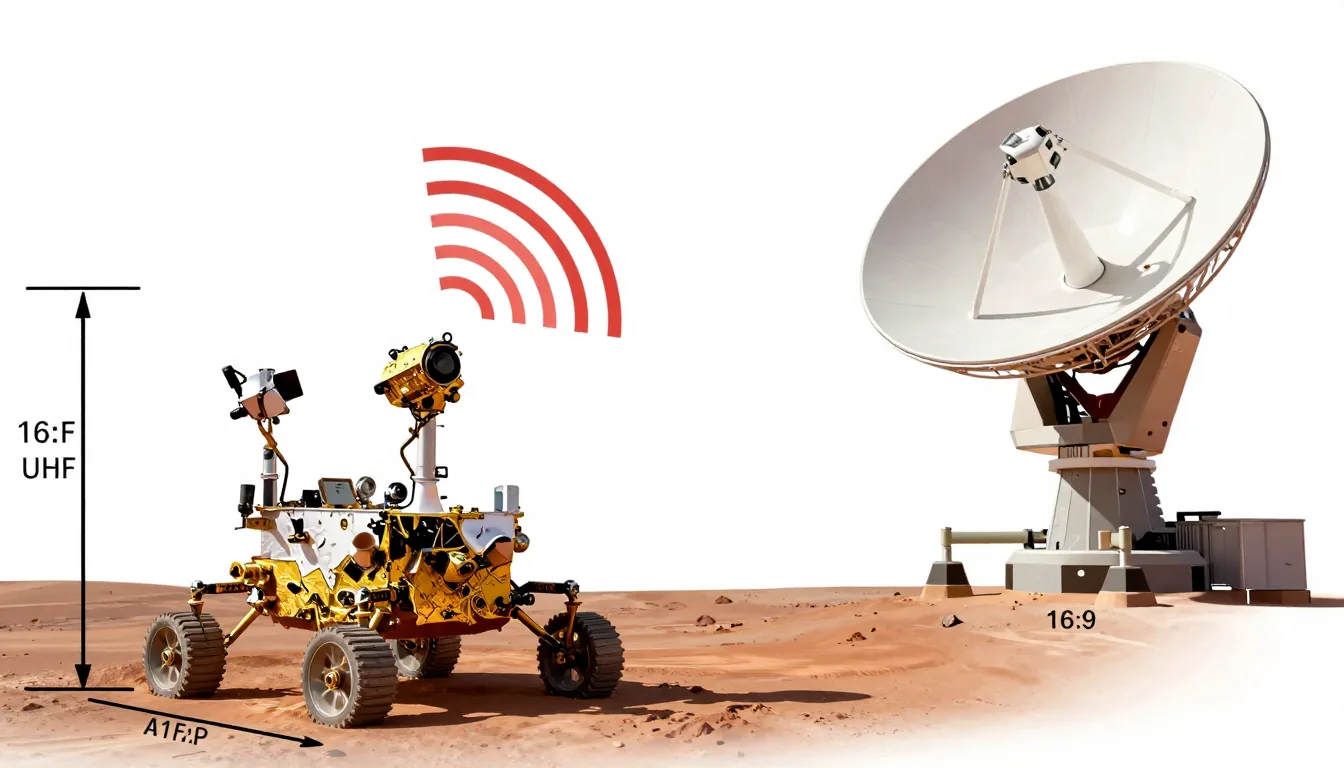
The rover’s UHF (ultra-high frequency) radio—around 400 MHz—can talk to an orbiter passing overhead for about 8 minutes each day.
During those windows, the rover dumps all its stored data: images, science data, even temperature logs. The orbiter then stores that data and transmits it to Earth later, when it has a clear view of the DSN.
This relay method is a fundamental aspect of how do rovers communicate with Earth.
This two-stage approach dramatically increases data volume. For example, Mars Express (an ESA orbiter) can relay up to 100 megabits per pass, while MRO can handle over 300 megabits.
Without relays, data rates would be much lower.
Without relays, a rover would have to send data directly at much lower rates, maybe 1 kbps. So those whisper-quiet signals from the surface are actually shouts to a nearby relay in the sky.
Frequency bands also matter. X-band (8–12 GHz) is the workhorse for deep space, but Ka-band (32 GHz) offers higher bandwidth—allowing more data per second.
Perseverance is the first rover to include a Ka-band tweak, doubling the direct-to-Earth data rate. Future missions may move to optical communication (laser light), which could send data at hundreds of megabits per second.
Imagine a rover snapping a 4K video and sending it back in seconds instead of hours.
The Future: Laser Links and AI
NASA’s Laser Communications Relay Demonstration (LCRD) is already testing this. In 2023, it beamed a video of a cat from deep space back to Earth at 200 Mbps.
For Mars, such technology could revolutionize how do rovers communicate with Earth, enabling real-time HD video feeds.
That would be a cosmic leap from the grainy, black-and-white images of the first rovers. It will redefine how do rovers communicate with Earth, opening a window to real-time exploration.
Artificial intelligence also helps.
Rovers now use intelligent “data triage” to prioritize what to send. Perseverance’s AEGIS system can identify interesting rocks and send only the best photos, not every snapshot.
This saves bandwidth and speeds up science. As computing power grows, rovers will become even more autonomous, deciding what to transmit without waiting for commands.
Why It Matters
Understanding how do rovers communicate with Earth reveals the ingenuity of human exploration. Every image of Martian sunsets, every soil sample analysis, is a triumph over vast distances and cosmic noise. The DSN and relay orbiters form a silent network that connects our world to another, turning a barren planet into a place we can touch, listen to, and dream about.
Next time you see a photo from Mars, remember: that picture traveled 225 million kilometers, hopped from a rover to an orbiter, then to a giant dish on Earth, all while battling signal loss and time delays. It’s not just a photo—it’s a cosmic postcard, sent with care from the red sands of Mars to your screen.