

What Would Happen If You Fell into Jupiter? The First Seconds
What would happen if you fell into Jupiter? This question has fascinated space enthusiasts for decades, and the answer involves a rapid, catastrophic sequence.
The initial entry at over 50 km/s would generate a fireball hotter than the Sun's surface, instantly vaporizing any spacesuit and reducing your body to plasma.
Even if you could somehow survive this blast, which is impossible, the descent into the ever-thickening atmosphere would subject you to forces beyond human endurance. The Galileo probe in 1995 offered real data: it survived just 58 minutes before signal loss, descending only 156 km into the gas giant—a tiny fraction of Jupiter’s depth.
This demonstrates that a human would have no chance; understanding what would happen if you fell into Jupiter requires accepting immediate obliteration. The only mercy is that death would be near-instantaneous.
The Pressure and Temperature Gauntlet
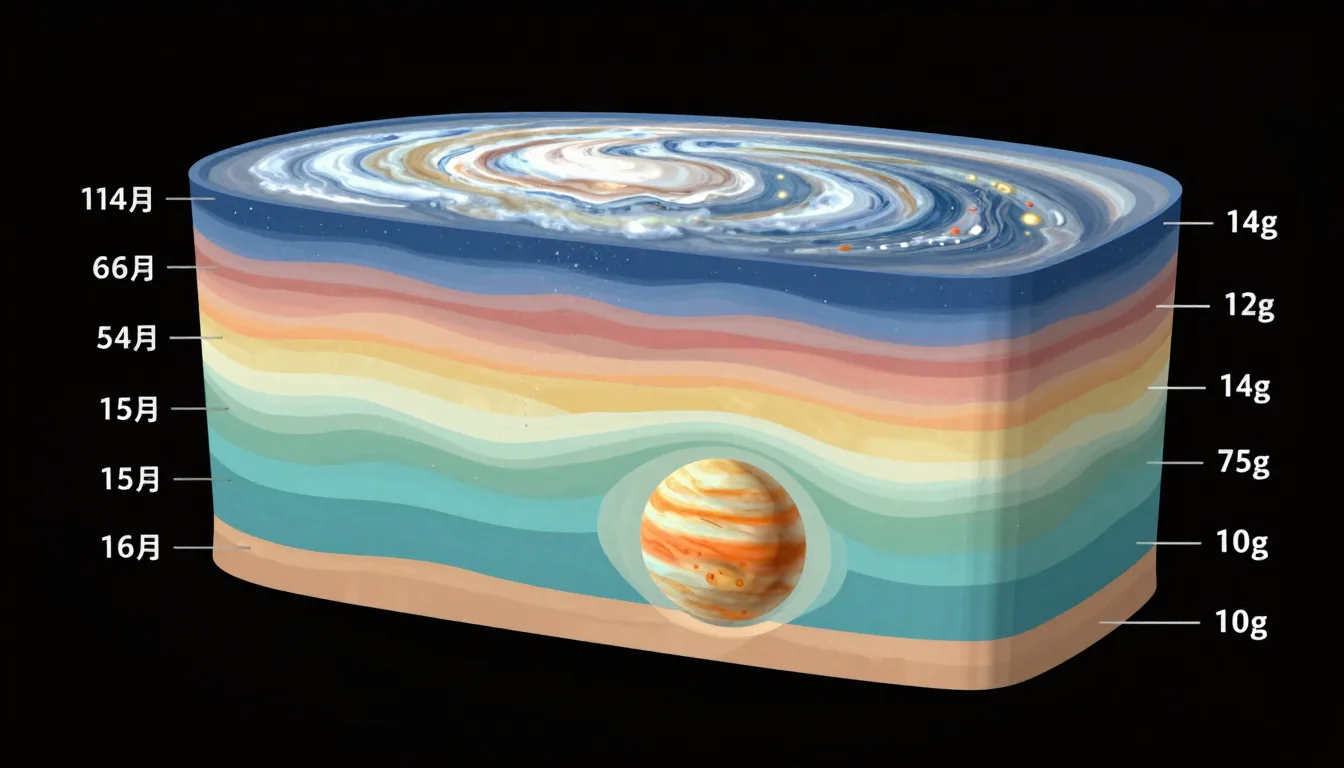
Within the first 200 km, pressure exceeds 100 Earth atmospheres, collapsing any air pockets and liquefying nitrogen in the lungs. At 500 km, pressure reaches a thousand bars—enough to crush spacecraft into coffee-can sized lumps.
Temperatures soar past 5,000°C, hotter than the surface of most stars. No known material can withstand such extremes; even diamond would vaporize.
The combination of crushing pressure and infernal heat ensures that nothing survives the descent.
Real Data from the Galileo Probe
In 1995, NASA's Galileo probe entered Jupiter's atmosphere at 47 km/s. It transmitted data for 58 minutes, revealing winds over 700 km/h and pressures 20 times Earth's at just 156 km depth.
The probe was eventually crushed and melted—a fate that would be identical for any human.
This mission taught us that the pressures increase by a factor of 1,000 every few hundred kilometers, with no solid surface to stop the fall.
Descent Through the Liquid Hydrogen Layer
Below about 1,000 km, atmospheric hydrogen and helium condense into a liquid ocean without a surface. The pressure here is millions of bars, forcing hydrogen into a metallic state that conducts electricity and generates Jupiter’s immense magnetic field.
Your body would be torn apart at the molecular level, its components dissolving into the planet’s primordial soup. The temperature remains in the thousands of degrees, ensuring complete destruction.
The Mysterious Core
If you somehow reached the core, you’d encounter a dense sphere of rock and metal under pressures of tens of millions of bars and temperatures exceeding 20,000 K. At such extremes, matter exists in exotic supercritical states, and atoms themselves begin to break down.
Current models suggest the core is about 20 times Earth’s mass but only slightly larger in diameter. However, no human technology could ever approach it; the journey would end in total destruction long before.
Some have speculated about protective capsules, but the pressures and temperatures far exceed any engineering limits. The question of what would happen if you fell into Jupiter is fundamentally one of destruction—there is no escape, no survival strategy.
This is why Popular Science & Space often discusses the immense challenges of exploring gas giants. For more details, check out NASA’s Jupiter exploration page or Space.com’s breakdown of this gas giant’s deadly environment.
Conclusion: The Final Verdict
Falling into Jupiter means instant obliteration—there are no survivors, no last-minute escapes. The only way to avoid this fate is to never fall at all.
As we continue to explore the solar system, Jupiter stands as a stark reminder of nature's power and our own fragility.
In summary, what would happen if you fell into Jupiter? You would be crushed, burned, and dissolved into the planet's core, leaving no trace behind.
It's a humbling thought for any aspiring astronaut, reminding us of our place in the vast cosmos.