
What Is Dark Matter and Why Can’t We See It?
Dark matter is one of the universe’s greatest mysteries, but astronomers use advanced dark matter mapping techniques to study it. It makes up about 27% of the cosmos, yet it emits no light, no radiation, and interacts only through gravity.
Scientists know it’s there because of its gravitational pull on visible matter. Without dark matter, galaxies would fly apart, and the cosmic web would look entirely different.
These dark matter mapping techniques have evolved over decades, combining data from telescopes and satellites to probe the invisible.
Galaxy Rotation Curves: The First Clue
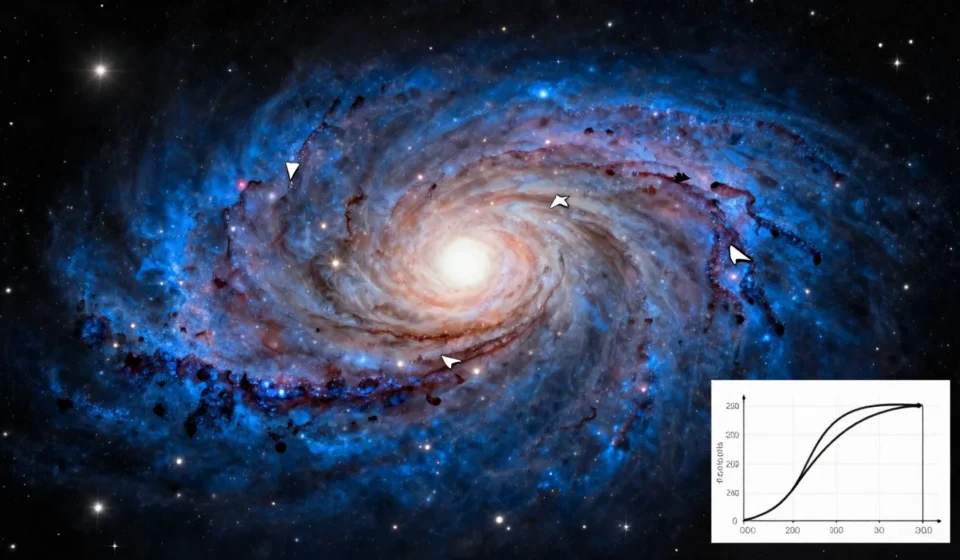
In the 1970s, astronomer Vera Rubin noticed something odd. Stars at the edges of spiral galaxies moved just as fast as those near the center, defying Newton’s laws.
If only visible mass existed, outer stars should slow down like planets far from the Sun. But they didn’t—implying a halo of invisible matter enveloping each galaxy.
Such rotation curves are a cornerstone of dark matter mapping techniques, revealing mass distributions invisible to optical telescopes.
These galaxy rotation curves remain one of the strongest pieces of evidence for dark matter. Astronomers now map these curves to infer its distribution.
How Rotation Curves Reveal Dark Matter’s Shape
By measuring the velocity of stars and gas at different radii, scientists build a curve. A flat or rising curve signals extra mass beyond what we see.
This method works for individual galaxies and clusters, helping create a 3-D map of dark matter’s gravitational footprint.
Gravitational Lensing: Bending Light to See the Unseen
Einstein’s general relativity predicted that massive objects warp spacetime. Light traveling through this warped space bends, acting like a lens.
When a massive galaxy cluster sits between Earth and a distant galaxy, the cluster’s gravity distorts the background image into arcs or multiple copies. This gravitational lensing effect is one of the most powerful dark matter mapping techniques available to astronomers.
Strong vs. Weak Lensing
Strong lensing produces dramatic rings and arcs, visible in Hubble images. Weak lensing subtly stretches galaxy shapes, requiring statistical analysis of thousands of galaxies.
Both techniques allow astronomers to calculate the mass of the foreground cluster—most of which is dark matter. By combining many lenses, they create a comprehensive dark matter map.
Dark Matter Mapping Techniques: From Observations to Simulations
Observations alone aren’t enough. Supercomputer simulations like the IllustrisTNG project model how dark matter evolves over billions of years.
These simulations reproduce the large-scale structure we see: filaments, voids, and clusters. Comparing them to lensing and rotation data refines our understanding of dark matter’s behavior.
One powerful example of these techniques in action is the Bullet Cluster, where the collision of two galaxy clusters separated the hot gas from the dark matter. By mapping the gravitational lensing signal, scientists showed that the dark matter passed through while the gas interacted, providing direct evidence for dark matter’s existence.
By cross-referencing lensing maps with galaxy rotation curves, astronomers can verify the consistency of dark matter mapping techniques across different scales.
For more on how simulations work, check out this Space.com overview.
Future Tools for Dark Matter Mapping
New observatories like the Nancy Grace Roman Space Telescope and the Euclid mission will map billions of galaxies. They’ll measure weak lensing with unprecedented precision.
These missions will help pin down dark matter’s properties and maybe even reveal its particle nature. The hunt is on.
With advanced mapping methods, astronomers hope to solve the mystery.
Learn more about Euclid’s goals at ESA’s Euclid page.
Why It Matters
Understanding how to map dark matter isn’t just academic. It shapes our models of galaxy formation and the fate of the universe.
Every new map brings us closer to answering: What is dark matter? Until we catch a direct signal, gravity remains our best detective.
The combination of these methods forms a cohesive picture of dark matter’s distribution, validating the dark matter mapping techniques we use today. For a deeper dive, visit our Popular Science & Space section.