
Beginner Linear Progression Program: Why It Works
You don’t need fancy programming to build strength fast. A beginner linear progression program is the most efficient way to add weight to the bar every session. Your body adapts quickly to consistent overload, so you can increase load weekly.
This 4-week template strips away complexity. You'll squat, bench, deadlift, press, and add pulling work.
No fluff, just results.
The Program: 3 Days Per Week

You train Monday, Wednesday, Friday. Each day focuses on compound lifts.
Start with weights that allow clean reps—don't ego lift.
Add 5–10 pounds each week. This steady progression sparks muscle and strength gains.
Consistency is key. The split alternates between two workouts, ensuring balanced development.
On Day A and Day C, you squat and bench twice weekly. Deadlifts occur once on Day B.
This frequency maximizes neural adaptations.
Day A (Monday)
- Squat: 3 sets of 5 reps
- Bench Press: 3 sets of 5 reps
- Barbell Row: 3 sets of 5 reps
Day B (Wednesday)
- Squat: 3 sets of 5 reps
- Overhead Press: 3 sets of 5 reps
- Deadlift: 1 set of 5 reps
Day C (Friday)
- Squat: 3 sets of 5 reps
- Bench Press: 3 sets of 5 reps
- Barbell Row: 3 sets of 5 reps
Weekly Load Increases and Deload Schedule
Each week, add 5 lbs to upper body lifts and 10 lbs to lower body lifts. But after 4 weeks, you need a deload.
Drop weights to 60% of your working sets for one week. This prevents burnout and lets your joints recover.
If you fail to complete all reps, repeat the same weight next session. If you fail twice consecutively, reduce the load by 10% and build back up.
This keeps progress steady.
Sample Progression (Bench Press)
Week 1: 95 lbs. Week 2: 100 lbs.
Week 3: 105 lbs. Week 4: 110 lbs.
Deload Week: 65 lbs.
Track every lift. Write down your sets, reps, and weights.
Use a notebook or app to monitor trends.
Deadlift and Squat Rules
Your deadlift is one heavy set of 5. No need for multiple sets—the deadlift taxes your CNS.
On Day B, after squats, you're already warm.
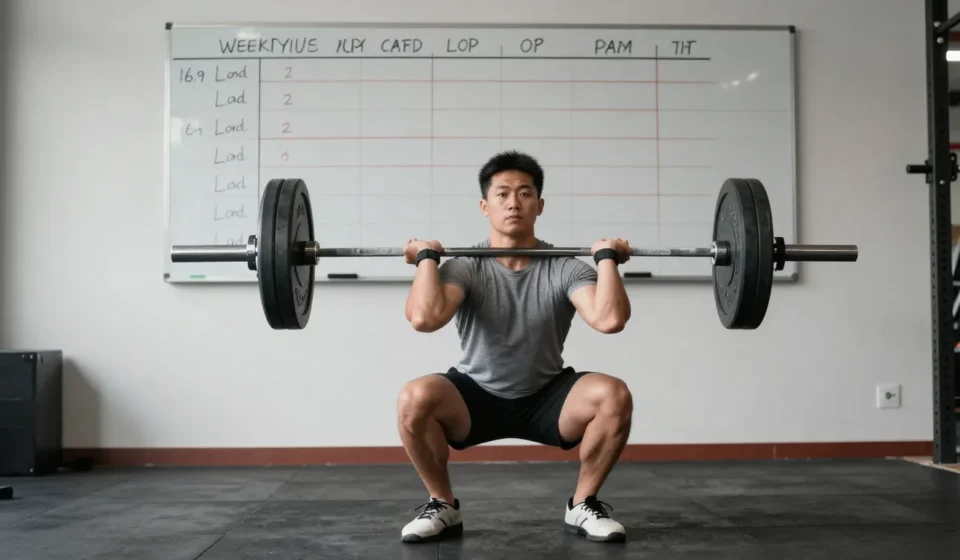
For squats, depth matters. Break parallel.
Keep your chest up and knees tracking over toes. Film yourself if needed to check form.
Brace your core before each rep. Inhale at the top, hold your breath during the descent, and exhale on the way up.
This stabilizes your spine.
Warm-Up and Cool-Down
Before each session, do 5 minutes of light cardio and dynamic stretches. Then perform 2 warm-up sets of the first exercise with 50% of your work weight.
Include leg swings, hip circles, and arm rotations for 5 minutes. This preps your joints and increases blood flow.
After training, stretch your quads, hamstrings, and chest for 10 minutes. Hold each stretch for 30 seconds.
This reduces soreness and improves flexibility.
Nutrition and Recovery
You can’t out-train a bad diet. To make this beginner linear progression program work, prioritize protein: 1.6–2.2 g per kg of bodyweight.
Sleep 7–9 hours. Linear progression demands recovery. Stick with this Fitness & Sports foundation for 4 weeks.
Also focus on hydration. Drink at least 3 liters of water daily.
Eat carbohydrates around your workouts for energy. Proper nutrition amplifies your results.
Then retest your maxes. For more on progressive overload, read StrongLifts and Starting Strength. Also check this study on periodization.
Final Cues
Stay consistent. Don't skip workouts.
This beginner linear progression program forces adaptation.
Your template is free—use it. Add 5–10 lbs every week for 4 weeks, then deload.
Repeat as long as you can progress.
Start your journey with confidence. The beginner linear progression program is proven for novices.
Commit to 4 weeks of disciplined training and watch your strength soar.