
The Physics of Inertia: Why Everything Flies East
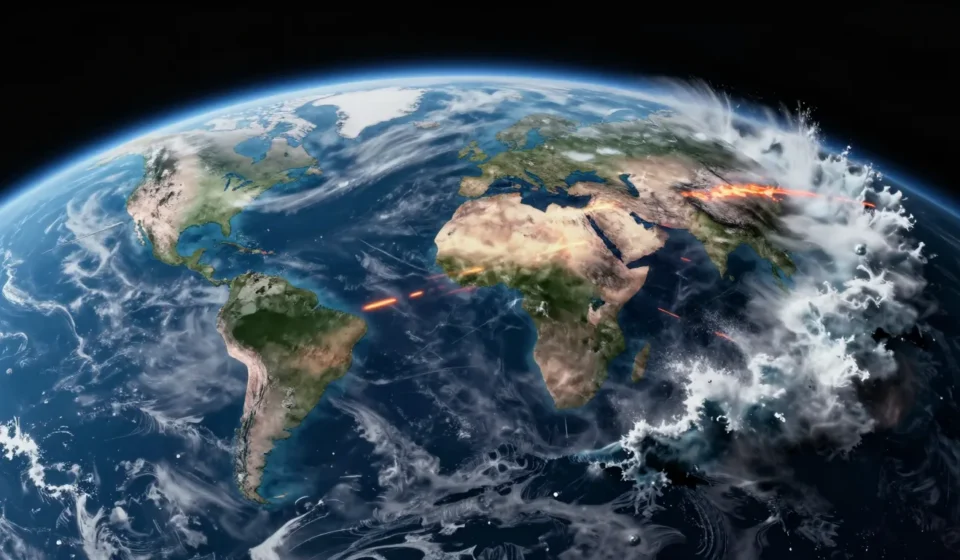
If Earth stops spinning suddenly, inertia would fling everything eastward at over 1,000 miles per hour near the equator. Imagine braking a speeding car—your body continues forward.
Now multiply that by planet-scale velocity.
Buildings would crumble as foundations tear east. Oceans would slosh violently, creating towering walls of water.
The atmosphere itself would keep spinning, generating winds faster than any hurricane.
The sudden deceleration would release colossal energy, equivalent to detonating billions of nuclear bombs. Everything not bolted down becomes a projectile.
This is the ultimate consequence if Earth stops spinning.
If Earth Stops Spinning, Oceans Become Megatsunamis
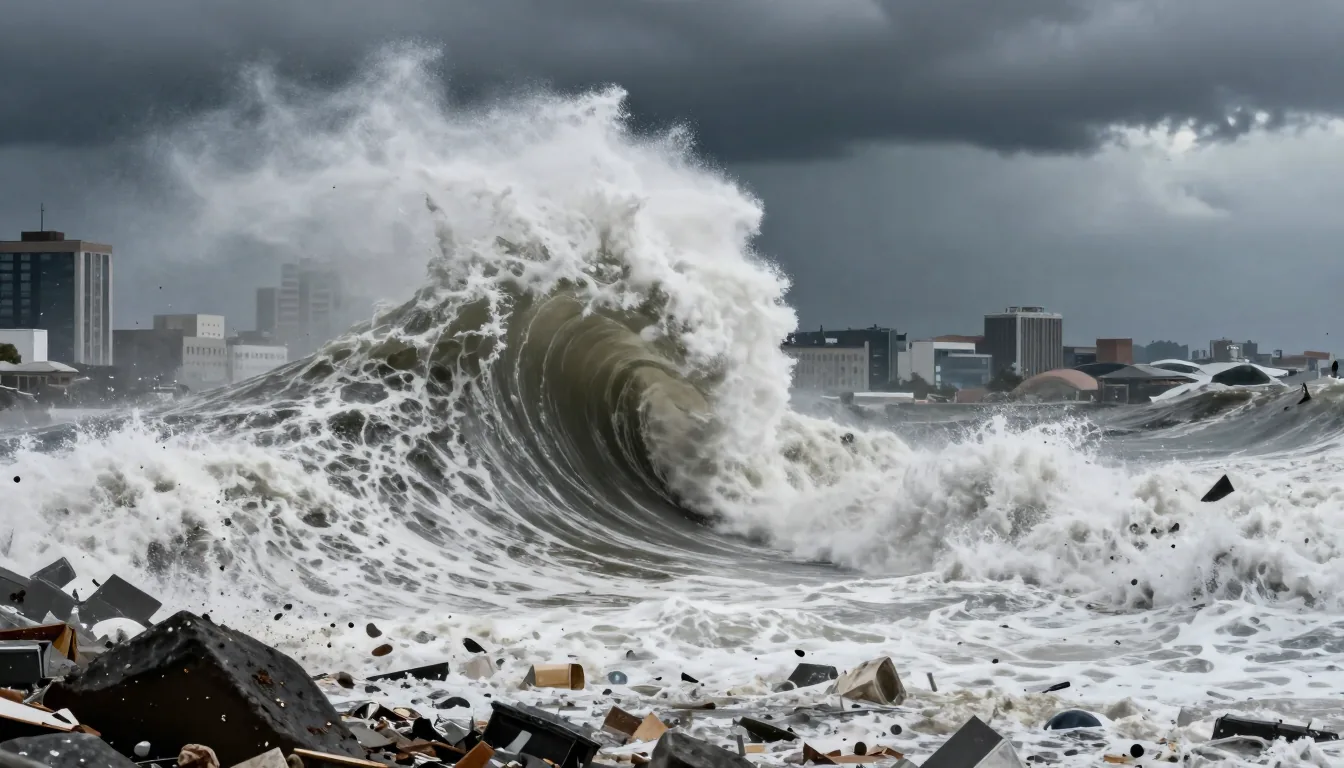
The ocean’s momentum would surge eastward, forming megatsunamis miles high. Coastal cities like New York, Tokyo, and Mumbai would be erased in minutes as water rushes inland.
These waves would propagate hundreds of miles, reshaping continents. No seawall could withstand the force of a global water wall moving at supersonic speeds.
Tsunami Heights Beyond Imagination
The volume of water displaced would dwarf any recorded tsunami. Entire coastal ecosystems would vanish, leaving barren landscapes scoured to bedrock.
Geologists estimate the energy released would equal millions of nuclear bombs, triggering secondary earthquakes and volcanic eruptions. When Earth stops spinning, oceans don’t stop—they become weapons.
Underwater landslides would add to the chaos, dragging entire continental shelves into the deep.
Atmospheric Fury: Winds Faster Than a Nuclear Blast
Earth's atmosphere spins with the planet. When the ground stops, the air continues east at over 1,000 mph—faster than the speed of sound.
These winds would strip topsoil, flatten forests, and turn debris into projectiles.
Friction with the ground would generate extreme heat, igniting wildfires across entire continents. The air would become a superheated sandblaster, eroding mountains within hours.
The day Earth stops spinning, the winds will never cease.
Anything not anchored would become a deadly missile. Survivors in shelters would hear a continuous roar as the atmosphere rages outside.
The wind speeds would exceed the strongest tornadoes by an order of magnitude, scouring the land down to bedrock in many areas.
The Core’s Collapse: Magnetic Field Flicker and Geologic Chaos
Earth's solid inner core rotates differently from the mantle. A sudden stop would create immense stress, triggering global earthquakes and volcanic eruptions.
The magnetic field, generated by fluid motions in the outer core, could destabilize, exposing the planet to solar wind.
Without a magnetic shield, the atmosphere would slowly erode, and life would face deadly radiation. Geologic upheaval would last centuries, carving new mountain ranges and ocean basins.
When Earth stops spinning, the magnetic field flickers and may collapse.
The inner core might continue spinning for a while, but eventually friction would cause it to slow, releasing further seismic energy.
Long-Term Consequences: A New World Order
After the initial chaos, Earth would become a world of extremes. One hemisphere would face perpetual daylight, the other eternal night.
The equator would be a scorching desert, while poles freeze solid. If Earth stops spinning, the climate becomes unrecognizable.
Agriculture would cease worldwide. Survivors would need to live underground or in space.
The biosphere would collapse, leaving only extremophiles.
The lack of rotation would alter ocean currents and wind patterns completely, making large parts of the planet uninhabitable.
Humanity’s only hope might be to rely on orbital habitats or deep bunkers. But for most, the sudden stop means an instantaneous end.
What About Us? Survival in a New World
If you were in a reinforced bunker, you'd face months of storms, tsunamis, and earthquakes. The climate would become unrecognizable.
Even underground, resources would run out quickly.
Space agencies like NASA study planetary rotation hazards. For more on the physics of inertia, check The Physics Classroom. These concepts reveal how fragile our spinning home truly is.
Survival would require advanced technology and near-term self-sufficiency. Eventually, humanity might re-establish civilization in caves or shielded habitats.
The scenario of Earth stopping spinning is a stark reminder of our dependence on planetary motion.
- Gravity would remain unchanged, but the lack of centrifugal force would make you feel slightly heavier at the equator.
- The day-night cycle would vanish, with the Sun fixed in one spot.
- Global temperatures would become extreme, with the Sun-facing side burning and the dark side freezing.
Explore more mind-bending science in our Popular Science & Space archive.