
A Frozen Realm Beyond the Planets
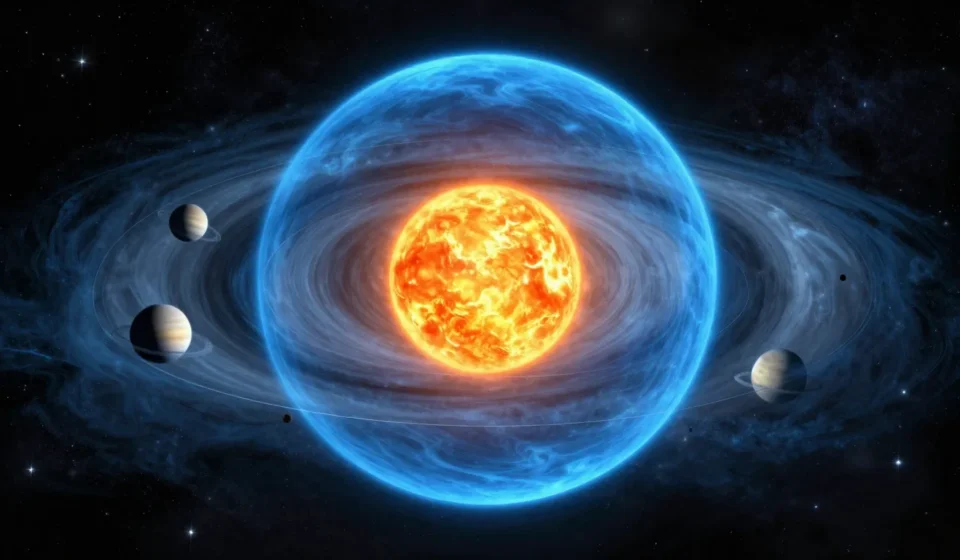
Far past the orbits of Neptune and Pluto lies a ghostly shell of ice and rock. But what is the Oort Cloud exactly?
It is a vast, spherical region surrounding our solar system at a distance of up to 100,000 astronomical units from the Sun. For context, that's nearly 2,000 times farther than Pluto.
Imagine a bubble made of trillions of frozen worlds, slowly drifting in eternal darkness.
Though we’ve never seen it directly, understanding what is the Oort Cloud explains the arrival of long-period comets—those that swing by Earth every few centuries. These icy visitors are like messengers from the outermost fringe, carrying clues about the dawn of our planetary system.
The Source of Long-Period Comets
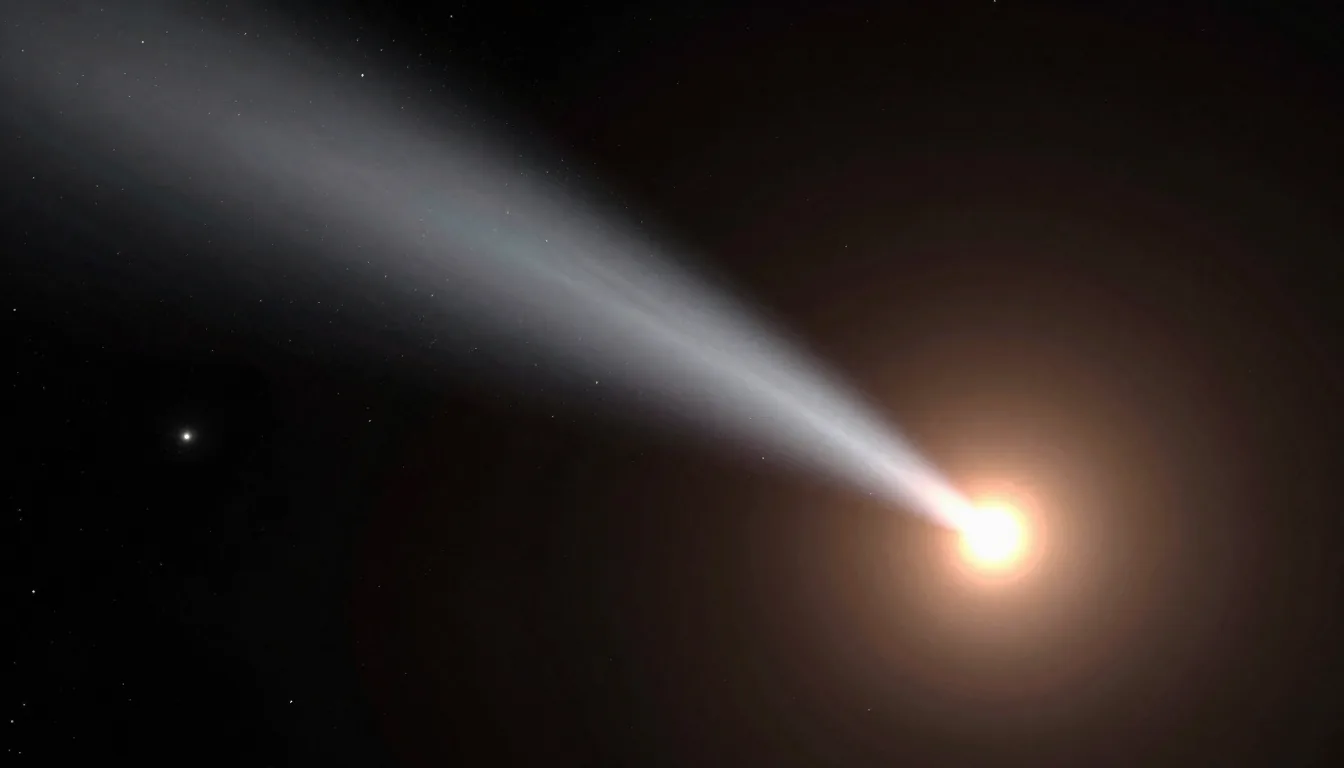
When a long-period comet like Hale-Bopp streaks across our sky, it's making a journey that began in the Oort Cloud. A slight gravitational nudge from a passing star or the Milky Way's tidal pull can send a frozen body hurtling inward.
As it nears the Sun, ice turns to gas, forming a glowing tail millions of kilometers long.
This reservoir of comets is truly staggering. Scientists estimate the Oort Cloud contains more than a trillion icy objects, each a pristine sample from 4.6 billion years ago.
It's a celestial freezer preserving the building blocks of our solar system.
What Is the Oort Cloud Made Of?
To grasp what is the Oort Cloud, we must consider its composition. It consists of a mix of water ice, methane, ammonia, carbon monoxide, and dust.
Some objects may be the size of mountains or even dwarf planets. Think of it as a cosmic compost heap of primitive material—unchanged since the solar system's infancy.
Unlike the Kuiper Belt, which contains larger objects like Pluto, Oort Cloud bodies are likely smaller and more uniform. Their chemical diversity makes them time capsules, holding clues to the interstellar medium that gave birth to our Sun.
How Did the Oort Cloud Form?
Billions of years ago, the young solar system was a chaotic nursery of planetesimals. As giant planets like Jupiter and Saturn migrated, they flung countless icy bodies outward.
Some escaped into interstellar space, but many were trapped by the Sun's gravity at extreme distances. Over time, these scattered objects settled into a spherical cloud, forming the Oort Cloud we know today.
This process explains why the cloud is spherical rather than flat like the Kuiper Belt. The Oort Cloud’s shape reflects its violent birth—a cosmic migration of worlds that left a halo of leftovers.
Why We Haven’t Seen It Yet
The question “what is the Oort Cloud?” persists because it is incredibly faint and distant—no telescope has directly imaged it. Even the Hubble Space Telescope can't spot a kilometer-wide iceball 50,000 AU away.
We only infer its existence from comet orbits. But indirect evidence is strong: the orbits of long-period comets point to a spherical source, and computer models confirm its plausibility.
Detecting the Oort Cloud remains a holy grail. Future instruments like the Vera Rubin Observatory might spot occultations—brief shadows when an Oort Cloud object blocks a distant star.
Until then, it remains a hidden frontier.
The Oort Cloud and Future Exploration
Could we ever visit the Oort Cloud? The Voyager probes will take tens of thousands of years to reach its inner edge.
But missions like the proposed Interstellar Probe aim to sample its material. Studying Oort Cloud comets up close could reveal the recipe for life—after all, these icy bodies may have delivered water and organics to early Earth.
Contemplating what is the Oort Cloud expands our perspective. For now, it stands as a reminder of our cosmic neighborhood's vastness.
It's the last outpost of the Sun's influence, where our star's gravity gives way to the galaxy.
Popular Science & Space explores more wonders like this. Check out NASA’s Oort Cloud page and Space.com’s guide for deeper dives.