
over-ear vs in-ear: Noise-Cancelling Showdown
Choosing between over-ear and in-ear headphones with active noise cancellation (ANC) is not about which is ‘better’—it’s about trade-offs. The over-ear vs in-ear debate hinges on how you prioritize comfort, audio fidelity, ANC performance, and portability. Let’s strip away the marketing and look at the hard specs and real-world usage.
Comfort and Isolation

Over-Ear: The Couch King
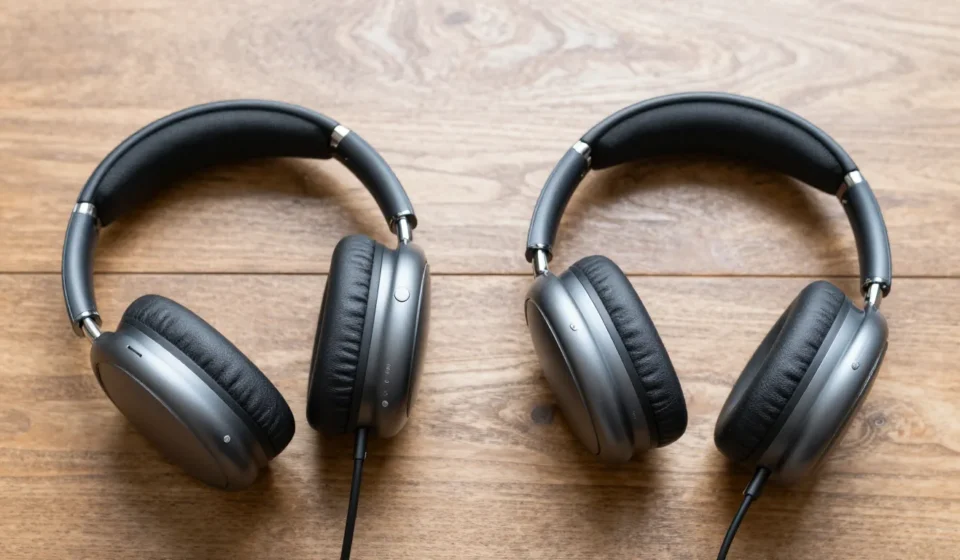
Over-ear headphones wrap your ears in plush padding, distributing pressure evenly. They are ideal for long listening sessions—think flights or work-from-home marathons.
When weighing over-ear vs in-ear, comfort is a key differentiator.
The larger ear cups create a physical seal that blocks high-frequency noise even without ANC. However, they can feel warm after hours of use, and some models clamp too tightly on larger heads.
In-Ear: Lightweight and Discreet
In-ear monitors (IEMs) with foam or silicone tips insert directly into the ear canal. They offer superior passive isolation for high frequencies but can cause discomfort during extended wear if the ear tips don’t fit properly.
Many users report ear fatigue after 2–3 hours. The tiny drivers also mean less physical mass, so they stay put during movement—great for commuting or gym use.
Audio Quality
Soundstage and Dynamics
Over-ear headphones typically deliver a wider soundstage and more accurate instrument separation. Larger drivers (40–50mm) can move more air, giving bass more punch and less distortion at high volumes.
In the over-ear vs in-ear audio debate, soundstage often tips the scales.
In-ear models, constrained by tiny drivers (6–12mm), often struggle with depth and treble extension unless you spend serious money on multi-driver hybrids.
Frequency Response Realities
IEMs can achieve remarkable clarity in the mids and highs—some even surpass over-ears in resolution. But low-end extension usually falls short.
Over-ears from brands like Sony and Sennheiser offer deep, rumbling bass that IEMs rarely match without venting that leaks noise.
For critical listening, over-ears win; for detail retrieval in quiet environments, high-end IEMs compete.
Noise Cancellation Effectiveness
The over-ear vs in-ear ANC gap is narrowing but still present. ANC algorithms on premium over-ears (Bose QC45, Sony WH-1000XM5) cancel a wider range of frequencies—especially low-frequency drone—than most in-ear models.
Why? Larger ear cups provide more space for multiple microphones and better feedback processing.
In-ear ANC (e.g., Sony WF-1000XM5, AirPods Pro 2) has improved dramatically; some now match over-ears for constant noises but still struggle with sudden sounds due to isolation differences.
Portability and Convenience
In-ears fold into a case smaller than a deck of cards—perfect for daily carry. Over-ears require bulky carrying cases and take up significant bag space.
For portability, over-ear vs in-ear is a clear win for the latter.
If you commute or travel light, in-ears are the obvious choice. Over-ears offer longer battery life (30–40 hours vs 6–9 hours for true wireless) and often have physical buttons that are easier to use blind.
In-ears rely on touch controls that can be finicky.
Durability and Practicality
Over-ears suffer from creaking headbands, peeling ear pads, and tangled cables (wireless models mitigate this). In-ears lose tiny eartips and are vulnerable to sweat damage unless IP-rated.
Both require care, but in-ears are more easily replaced if lost.
For gym use, in-ears with ear hooks are safer; over-ears will slide off during exercise.
Price and Value
Over-ears typically cost more than in-ears at similar performance levels, but they often include more features like longer battery life and better build quality. For budget-conscious buyers, the over-ear vs in-ear price difference can be significant.
In-ears offer a lower entry point for decent ANC, but premium models quickly close the gap. Consider your use case: if you need a single device for all scenarios, over-ears may offer better longevity.
In-ears are more replaceable and often come with multiple ear tip sizes to improve fit.
Ultimately, the over-ear vs in-ear choice depends on your priorities.
Which Should You Buy?
If you prioritize comfort for long sessions, soundstage, and best-in-class ANC—and don’t mind the bulk—go for over-ears. If you value portability, discreetness, and decent ANC for commuting, in-ears are the practical pick.
There’s no universal winner; it’s about matching the form factor to your daily routine. For a deeper look at more Tech & Gadgets comparisons, check our other guides.
For further reading, see RTings’ in-ear ANC tests and SoundGuys’ over-ear ANC roundup.