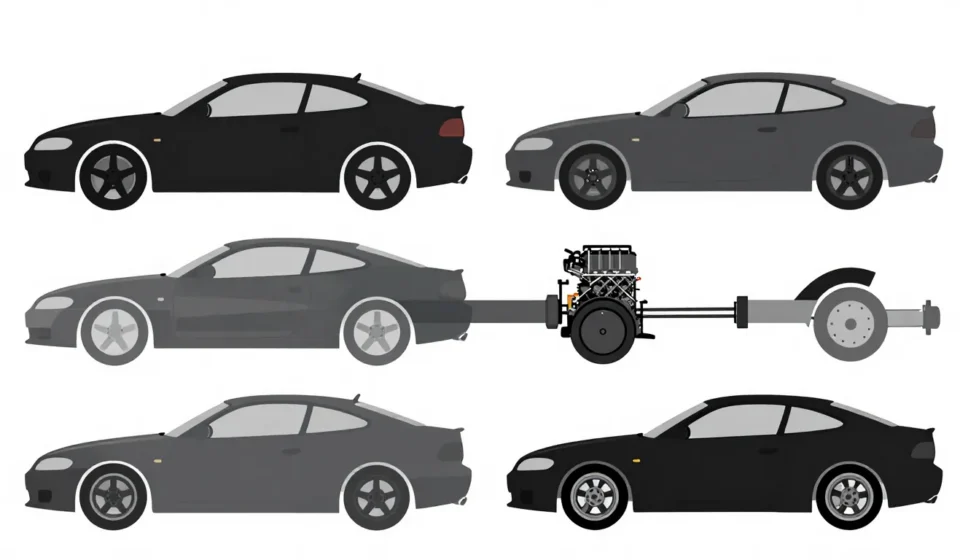

Drivetrain Layout Comparison: Weight Distribution Fundamentals
The drivetrain layout comparison begins with weight distribution. Front-engine, front-wheel drive (FF) layouts place the heaviest components over the driven wheels, resulting in approximately 60-65% front bias under static conditions.
This configuration simplifies packaging and reduces cost, but compromises rear traction during acceleration. Rear-wheel drive (FR) layouts achieve near 50:50 distribution in many sedans, enhancing balance.
All-wheel drive (AWD) adds a transfer case and driveshaft, typically increasing front weight by 2-5% over equivalent RWD. Mid-engine layouts push the engine behind the driver, achieving 40:60 or even 42:58 rear bias, ideal for cornering.
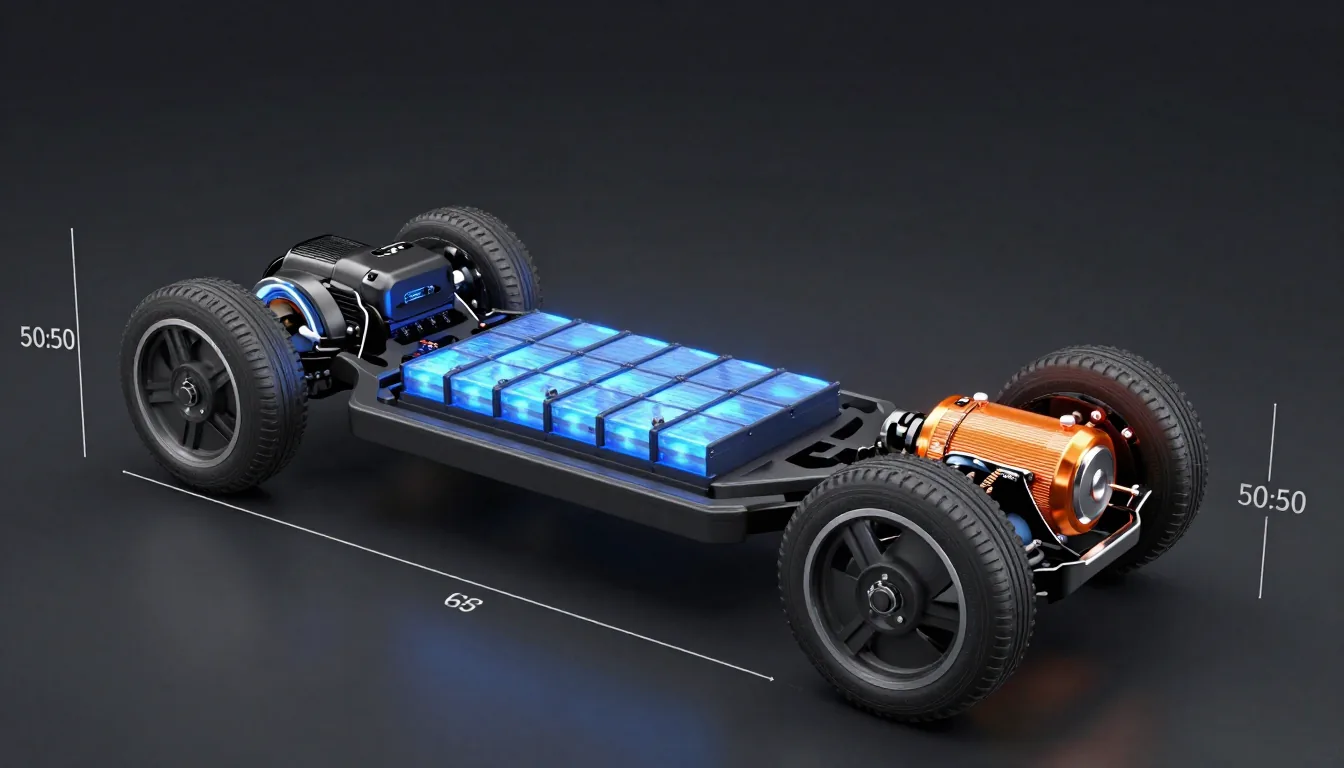
Electric vehicles (EVs) with skateboard batteries achieve near 50:50 distribution regardless of drive type, as the battery pack is centralized.
Front-Wheel Drive Characteristics
Traction and Understeer Tendencies
Front-wheel drive systems benefit from engine weight over the driven wheels, providing good traction in low-grip conditions. However, during hard cornering, the front tires must handle both steering and propulsion forces, leading to progressive understeer.
Torque steer is common in high-power FWD cars due to unequal half-shaft lengths. Modern electronic stability control mitigates these issues, but the fundamental limit remains that maximum lateral acceleration is lower than RWD or AWD.
In wet or snowy conditions, FWD is generally superior to RWD for straight-line traction but suffers from reduced steering feel. Within the drivetrain layout comparison, front-wheel drive stands out for its efficiency and cost-effectiveness.
Rear-Wheel Drive Benefits
Balance and Oversteer Dynamics
Rear-wheel drive separates steering and driving forces, allowing front tires to focus on cornering while rear tires provide thrust. This yields superior handling balance and the ability to rotate the car with throttle—ideal for performance driving.
Weight distribution near 50:50 enables neutral cornering, but RWD requires careful modulation to avoid oversteer. In low traction, RWD is less capable than FWD or AWD, especially from a standstill on loose surfaces.
The drivetrain layout comparison highlights rear-wheel drive’s dynamic advantages. With proper tires and limited-slip differentials, RWD offers the most engaging driving experience.
All-Wheel Drive Traction Analysis
Torque Distribution and Grip
All-wheel drive systems distribute torque to all four wheels, maximizing traction on slippery surfaces. Early systems used fixed 50:50 splits, but modern active systems vary torque between axles and even individual wheels via torque vectoring.
While AWD adds weight and driveline losses (typically 3-5% fuel economy penalty), it provides immense cornering grip and throttle predictability. Subaru’s symmetrical AWD and Audi’s quattro are benchmark examples.
In dry conditions, AWD can mask driver errors, but understeer still occurs if power is biased frontward. Performance-oriented AWD systems (e.g., Nissan GT-R, Porsche 911 Turbo) use rear bias for handling balance.
All-wheel drive adds complexity to the drivetrain layout comparison.
Mid-Engine Layout Dynamics
Centered Mass and Agility
Mid-engine placement centralizes mass between axles, giving the lowest polar moment of inertia and best turning response. Classic exotics like Ferrari 488 and Lamborghini Huracán use this layout.
Weight distribution typically favors the rear slightly, aiding traction during acceleration. The trade-off is limited practicality (small trunk, cabin noise) and a tendency for lift-off oversteer if the rear becomes too light under braking.
Mid-engine layouts excel in any drivetrain layout comparison for handling. With modern electronics, mid-engine cars remain the gold standard for lap times and driver feedback.
Electric Vehicle Platform Considerations
Skateboard Battery and Motor Placement
EVs eliminate the need for a longitudinal engine, allowing flexible motor placement. Single-motor EVs are typically rear-wheel drive (e.g., Tesla Model 3 RWD) for efficiency, while dual-motor variants achieve instantaneous torque vectoring.
Battery packs mounted under the floor lower the center of gravity, often below the wheel centers, dramatically reducing body roll. Weight distribution remains near 50:50 regardless of drive type.
This gives EVs inherent handling advantages, but their weight (often 20-30% more than equivalent ICE cars) requires stronger brakes and stiffer suspension. Electric vehicles redefine the drivetrain layout comparison due to packaging flexibility.
For further technical reading, visit Car and Driver and Road & Track. Explore more insights in our Automotive & Mobility category.