The Weight Debate: How Carbon Fiber, Aluminum, and Composites Transform Sports Car Performance

Why Mass Is the Enemy of Performance
In automotive engineering, every kilogram saved directly translates to faster lap times, sharper handling, and greater efficiency. Lightweight sports car materials such as carbon fiber, aluminum alloys, and advanced composites are now standard in high-performance vehicles, shifting the paradigm from brute power to intelligent weight reduction.
McLaren, Ferrari, and Porsche have all invested heavily in materials science to shed pounds without sacrificing rigidity.
The benefits extend beyond acceleration. Reduced mass lowers inertia, allowing brakes to dissipate heat more effectively and tires to maintain grip under load.
Fuel economy also improves, as lighter vehicles require less energy to propel. Below, we analyze the engineering trade-offs and real-world gains of three dominant lightweight materials.
Carbon Fiber: The Gold Standard of Lightweight Sports Car Materials
How Carbon Fiber Improves Acceleration and Handling
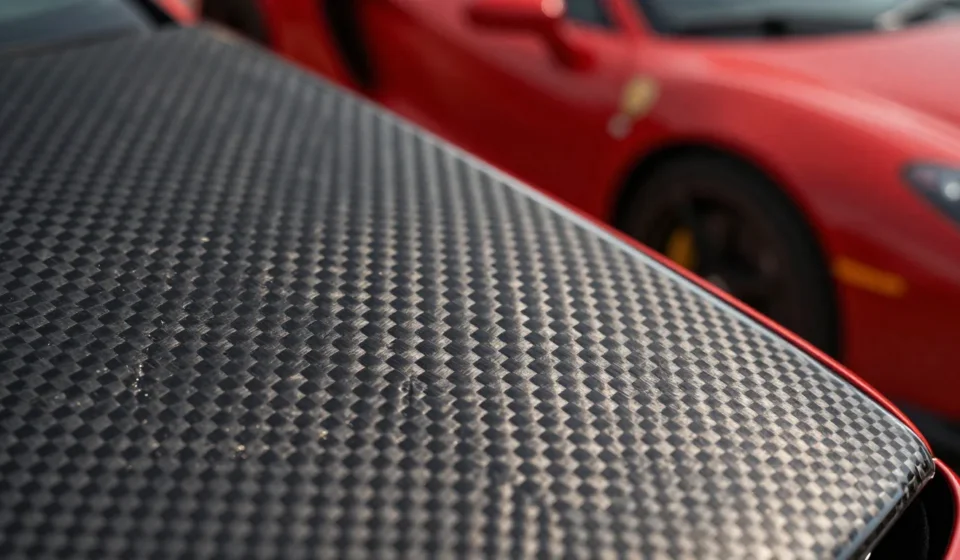
Carbon fiber reinforced polymer (CFRP) offers a strength-to-weight ratio five times that of steel. In the McLaren 720S, the Monocage II carbon fiber tub weighs just 75 kg while providing exceptional torsional rigidity.
This reduces curb weight to 1,283 kg, enabling a 0-100 km/h sprint of 2.7 seconds. The low rotational mass also sharpens steering response and reduces body roll during cornering.
This exemplifies how lightweight sports car materials directly impact performance.
However, carbon fiber is expensive and difficult to repair. Production costs limit its use to monocoques, body panels, and select chassis components.
For mainstream sports cars like the Chevrolet Corvette, carbon fiber is reserved for the hood or roof to keep pricing accessible while still saving 10–15 kg.
Aluminum Alloys: The Cost-Effective Performer
Aluminum’s Role in Braking and Fuel Economy
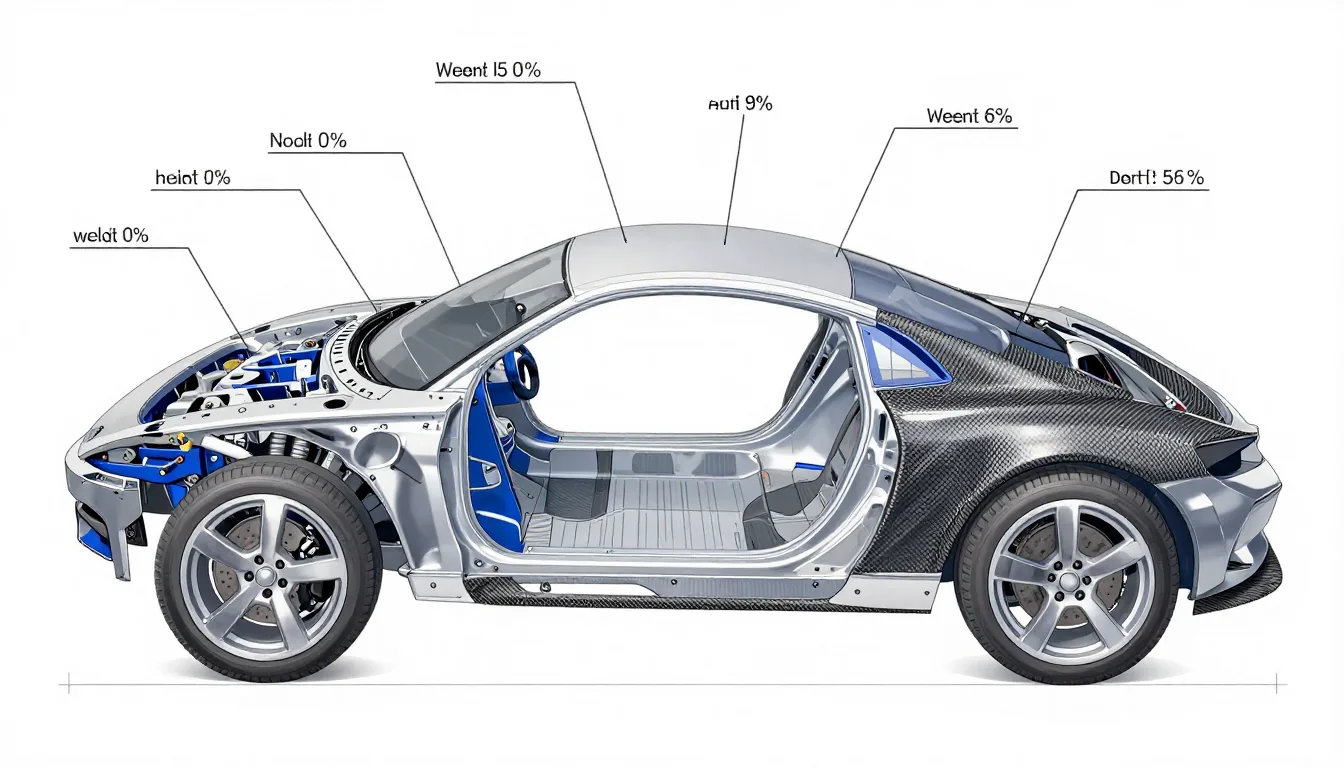
Aluminum is roughly one-third the weight of steel with comparable stiffness. The Audi R8 uses an aluminum space frame that weighs 200 kg less than a steel equivalent, lowering the center of gravity and improving brake fade resistance.
Lighter unsprung mass from aluminum control arms and knuckles allows suspension to follow road contours more precisely, enhancing traction. Aluminum remains a popular choice among lightweight sports car materials.
Fuel economy gains are measurable: a 100 kg reduction improves efficiency by 3–5% in real-world driving. The Jaguar F-Type achieves 6.5 L/100 km on the highway largely thanks to its aluminum-intensive body.
Repairability is easier than carbon fiber—aluminum panels can be welded or bonded using specialized techniques.
Advanced Composites: Balancing Weight and Cost
Composites in Structural and Aero Components
Glass fiber, Kevlar, and hybrid composites fill the gap between aluminum and carbon fiber. Composites represent an evolving category of lightweight sports car materials.
The Porsche 911 GT3 RS uses a front hood made of a carbon fiber–Kevlar blend, saving 4 kg over aluminum while resisting stone chips. These materials are also used in aerodynamic elements—front splitters, rear diffusers—where low weight and high stiffness improve downforce without adding mass.
BMW's i8 employed a carbon fiber–reinforced plastic passenger cell paired with aluminum suspension, achieving a 1,485 kg curb weight. Although production has ceased, the trend continues: the new Lotus Emira uses a bonded aluminum chassis with composite body panels, targeting under 1,400 kg.
Composites offer a middle ground: performance gains are 70% of carbon fiber's benefits at 40% of the cost.
Comparative Performance: Weight Reduction vs. Power Increase
Why Saving 100 kg Beats Adding 50 hp
Engineers commonly debate the equivalence of weight loss versus power gain. A 100 kg reduction improves acceleration by roughly 0.2 seconds to 100 km/h, but also enhances cornering speed, braking distance, and tire longevity.
For example, the Ferrari 488 Pista saved 90 kg over the 488 GTB using more carbon fiber and titanium, cutting 0.3 seconds off the 0–200 km/h time. Adding 50 hp would achieve a similar straight-line gain but worsen fuel economy and increase cooling demands.
The Future: Nanocomposites and Bio-Based Materials
Next-Generation Weight-Saving Innovations
Research into carbon nanotubes and graphene-infused composites promises even higher stiffness-to-weight ratios. McLaren has experimented with graphene-infused carbon fiber for the Speedtail, reducing weight by 2% while improving heat dissipation.
Next-generation lightweight sports car materials include nanocomposites that could further reduce mass. Bio-based composites using flax or hemp fibers are emerging in interior panels, offering renewable sources with decent strength.
These materials could reduce manufacturing carbon footprint while keeping weight low.
For buyers, the message is clear: choose a sports car with a lightweight architecture if performance and efficiency matter. Check our Automotive & Mobility category for more engineering deep dives. For official specs, visit McLaren’s official site and Porsche’s model pages.