
Why Weight Distribution Matters for Handling
Your car's handling is governed by how weight is distributed across the four corners. A proper weight distribution calculation reveals the static balance that dictates turn-in, mid-corner grip, and exit traction.
Without this data, suspension tuning is guesswork.
Most factory specs list a front/rear percentage, but that ignores cross-weight differences. The true corner weights determine whether your car rotates willingly or pushes wide.
This guide walks you through measuring and interpreting those numbers. Even small adjustments can transform a car's behavior, making it more predictable and enjoyable to drive.
Essential Tooling: Corner Scales and Setup
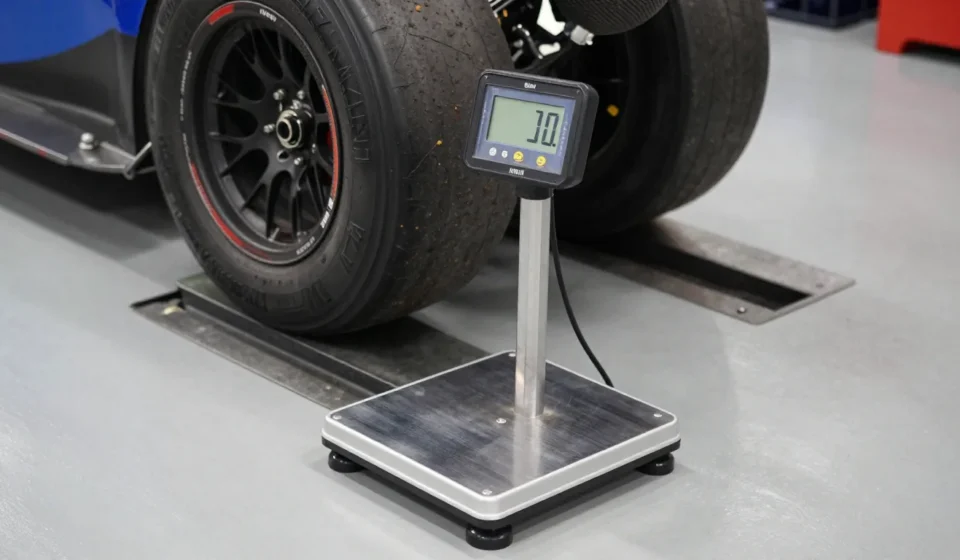
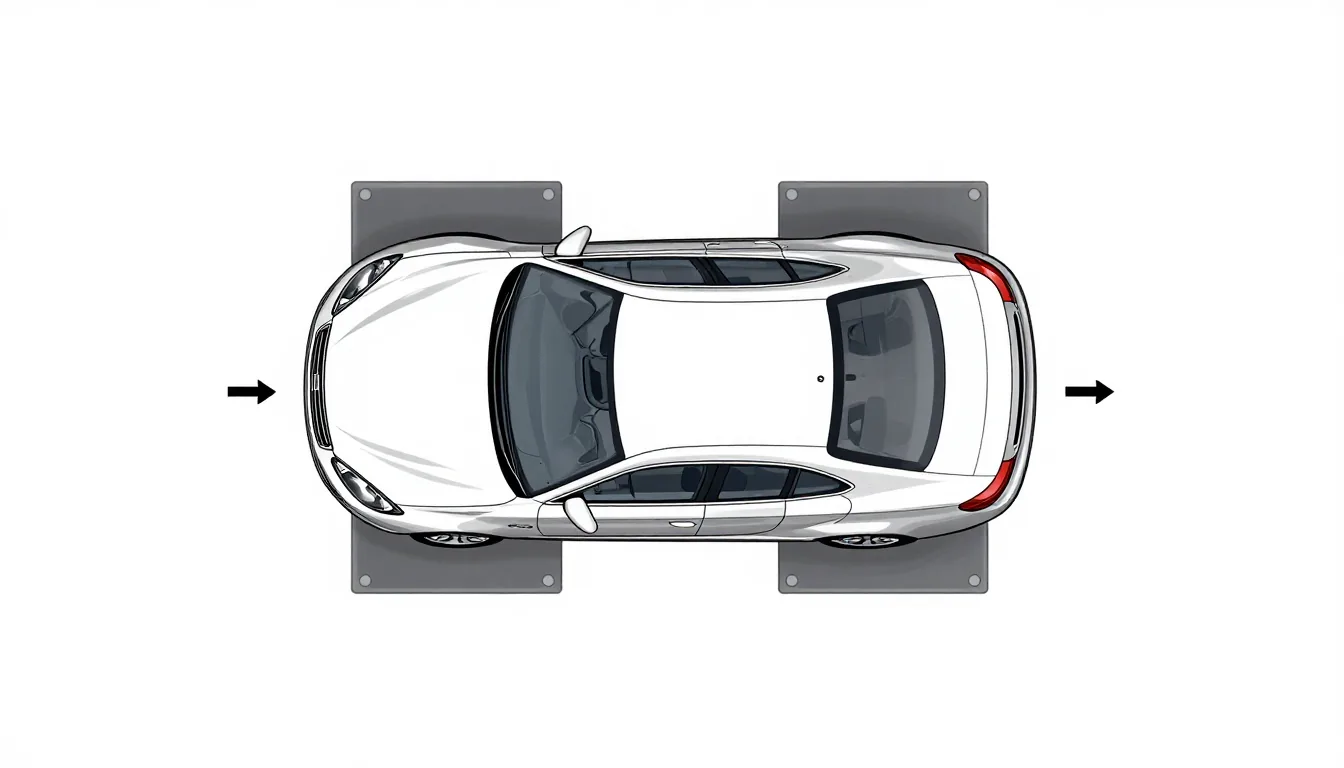
You need a set of four corner scales—platforms that measure each wheel's load. Professional units like Intercomp or Longacre are accurate to within 0.1%.
Ensure the scales are level and your car is at race weight with driver and fuel load.
Drive onto the scales in a straight line, release the steering wheel, and bounce the suspension to settle. Record each corner's reading in pounds or kilograms.
This raw data is the foundation for your weight distribution calculation.
Weight Distribution Calculation Steps
Add left front (LF) and right front (RF) to get total front weight. Similarly, sum rear (LR+RR).
Divide front total by overall weight, multiply by 100 for front percentage. Rear is 100 minus that.
For cross weight (wedge), add LF+RR and RF+LR, then divide the smaller sum by total weight and multiply by 100. Ideal wedge is 50%.
For example, a 3000 lb car with LF=750, RF=700, LR=800, RR=750 gives front weight 1450 lb (48.3%), cross weight (LF+RR=1500, RF+LR=1500) exactly 50%. If wedge deviates, the car will have asymmetric handling—tight in one direction, loose in the other.
Understanding these numbers is key to effective weight distribution calculation.
Adjusting Balance via Corner Weighting
Once you have the numbers, you can shift weight by adjusting spring preload or ride height. Raising a corner with a coilover collar adds load to that wheel and reduces load diagonally opposite.
This is how race engineers dial out wedge.
Target a 50% cross weight for most track cars. Street cars can tolerate small deviations.
Small incremental changes prevent overshooting the target and help you understand how each adjustment affects the overall balance. Always re-measure after each adjustment.
A precise weight distribution calculation allows you to achieve neutral handling without guessing.
Practical Tips for DIY Corner Balancing
Work on a perfectly flat surface—any slope skews readings. Use tire pressure gauges and ensure all tires are at optimum hot pressure.
Make small adjustments (1/4 turn) and re-scale.
Consider driver ballast if you frequently race alone. A 150 lb driver shifts weight bias; add ballast to the passenger seat to equalize.
Document each session's settings for repeatability.
Interpreting Results for Real-World Grip
A perfect static weight distribution calculation is only half the battle. Dynamic weight transfer during braking and cornering changes the effective distribution.
However, starting from a balanced static platform gives predictable transition behavior.
If your car understeers on entry, you may need more front weight or less rear. Oversteer on exit often indicates too much rear weight bias.
Cross-weight adjustments can fix asymmetry without altering overall balance.
For further reading on suspension geometry, visit Racecar Engineering and Car and Driver’s corner balancing guide. Also explore our Automotive & Mobility category for more tuning insights.
Conclusion
Master weight distribution calculation to unlock your car's full handling potential. The process is simple if you have quality scales and patience.
Regular checks after any ride height or spring change ensure your setup remains optimal. Consistency is key to maintaining peak performance.
Corner balancing is an art that rewards precision and careful record-keeping.
Remember, a well-balanced car is faster and safer. Invest in corner scales—they pay for themselves in lap time and tire life.